
Saturday, September 5, 2026

Pentagon Bans Claude as Nations Fracture Global AI Development Into Competing Ecosystems

The Pentagon banned Anthropic's Claude AI while India joined US semiconductor supply chains, marking a shift toward AI sovereignty. Industry leaders now debate whether AI power concentration stems from closed systems or geopolitical control, as regulatory actions and $110B infrastructure investments fragment the global AI landscape along national lines.

Pentagon Bans Claude as Nations Fracture Global AI Development Into Competing Ecosystems
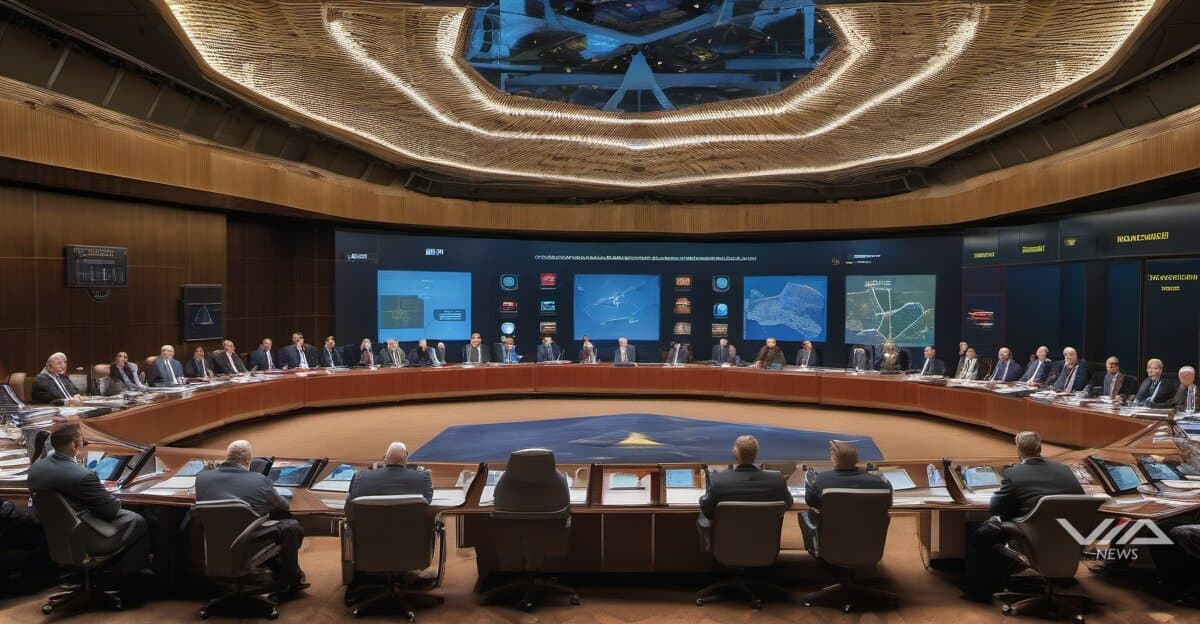
Image generated by AI for illustrative purposes. Not actual footage or photography from the reported events.
Loading stream...

The Pentagon banned Anthropic's Claude AI system from military use, part of a wave of regulatory actions fragmenting global AI development along national boundaries. India simultaneously joined US semiconductor supply chains, reinforcing emerging AI alliances based on geopolitical alignment rather than technical merit.

The fracturing extends beyond government policy. Reliance Industries chairman Mukesh Ambani committed $110 billion to AI infrastructure investments in India, building capacity independent of Western ecosystems. These parallel development tracks suggest nations are prioritizing sovereignty over interoperability in AI systems.

Arthur Mensch, CEO of Mistral AI, argues the real divide isn't geographic. "The fight for AI supremacy is between open versus closed systems rather than where those systems are built," he said. Luke Sernau of Google contends an "open-source free-for-all is threatening Big Tech's grip on AI," framing the split as ideological rather than territorial.

Legal pressures compound the governance crisis. Meta faces surveillance lawsuits over AI monitoring practices. Google confronts a wrongful death case involving AI-generated suicide instructions. These cases force companies to navigate conflicting regulatory frameworks across jurisdictions, with no international consensus on AI safety standards.

The technical implications run deep. Hidenori Tanaka of NTT Research notes that "AI is becoming ubiquitous, but how these computational engines actually work remains—to a surprising degree—a mystery." This opacity complicates attempts to regulate systems that even their creators don't fully understand.

The governance vacuum creates competing regulatory approaches. The US focuses on export controls and supply chain security. The EU prioritizes comprehensive AI legislation. China advances AI development through state coordination. India builds domestic capacity while aligning with US partnerships. Each model reflects different values around innovation, security, and control.

The fragmentation carries economic consequences. Companies must now design products for multiple regulatory environments or choose markets based on compliance costs. The global AI talent pool faces new mobility restrictions as nations treat AI expertise as strategic assets. Research collaboration slows as geopolitical tensions override scientific cooperation.

No unified framework appears likely soon. The diverging approaches suggest the emergence of separate AI ecosystems with limited interoperability, fundamentally reshaping how artificial intelligence develops globally.

Source documents

Via News is a conduit. We point to the source documents behind this report — we don't replace them. Trace any claim to its source and decide what to trust. How we source

Source Trace Score8 source documents8 with a live linkVerifiability: Strong
  1. [1]News articleSeeking Alpha· March 1, 2026
    Jefferies updates its AI Risk Basket
  2. [2]News articleYahoo Finance· February 20, 2026
    Modi’s Chaotic AI Summit Showed India’s Clout and Constraints
  3. [3]News articleYahoo Finance· December 3, 2025
    NTT Scientists Contribute Fifteen Research Papers to NeurIPS 2025
  4. [4]Press releaseGlobeNewswire· February 27, 2026
    Telix Joins Forces with University Hospital Essen on PROMISE-PET: Optimizing Patient Management through AI-enabled PSMA-PET Imaging
  5. [5]News articleMIT Technology Review
    The Download: an AI agent’s hit piece, and preventing lightning
  6. [6]News articleMIT Technology Review
    The Download: 10 things that matter in AI, plus Anthropic’s plan to sue the Pentagon
  7. [7]News articleIEEE Spectrum
    Video Friday: Autonomous Robots Learn By Doing in This Factory
  8. [8]News articleIEEE Spectrum
    Video Friday: Robot Collective Stays Alive Even When Parts Die

In this story

What we know · the intelligence behind this page
Live from the substrate
What we're seeing
AI Capital Surge Meets Investor Caution: Record Funding Rounds and Government Contracts Amid Valuation Skepticism
A single-week cluster of large AI/fintech funding rounds (Socure, Stability AI, Emerald AI, Generalist AI, Instinct, Gatik, Regent Craft) shows venture capital still pouring into AI infrastructure, identity, and autonomy plays, while Palantir's Army TITAN contract win coincided with a 6% stock drop — signaling that even flagship AI-defense revenue isn't immune to market reassessment of AI valuations. Efficiency-focused innovations like Multiverse Computing's model compression suggest the sector is also pivoting toward cost/inference economics as capital intensity draws scrutiny.
Our read on the data ›
Signals we're tracking
EPKINLY Regulatory-Clinical Success Cascade
High probability of expanded label indications, additional combination approvals, and competitive positioning strength in follicular lymphoma market. Predicts positive commercial uptake and potential accelerated review for related indications.
Patterns we're watching ›
Where sources disagree
Morgan Stanley & Co. LLC
The same metric (eps) for the same entity (Morgan Stanley & Co. LLC) reported for the identical fiscal period (Q1 2026) and observation date (2026-03-31) has two conflicting values: 3.43 USD_per_share vs 3.08 USD. This is not a temporal change — both observations claim to measure the same point in time. The ~10% discrepancy (0.35 USD difference) is material for a financial metric.
We flag conflicts openly ›
Recently verified
Checked against the original source
4,981
facts traced to their source — and we flag the ones that don't hold up.
101 entities tracked4,981 facts checked against source5,273 source documents archived
Query this data → isubstrate.com