
Saturday, September 5, 2026

AI Data Centers Move Offshore While Regional GPU Hubs Target Southeast Asia Market

Power and cooling constraints are pushing data center operators toward offshore wind-powered facilities, despite saltwater corrosion challenges. VCI Global's Malaysia GPU center and Nokia's AI-RAN partnerships address regional compute demand as semiconductor makers project mid-to-high teens growth in advanced packaging.

AI Data Centers Move Offshore While Regional GPU Hubs Target Southeast Asia Market
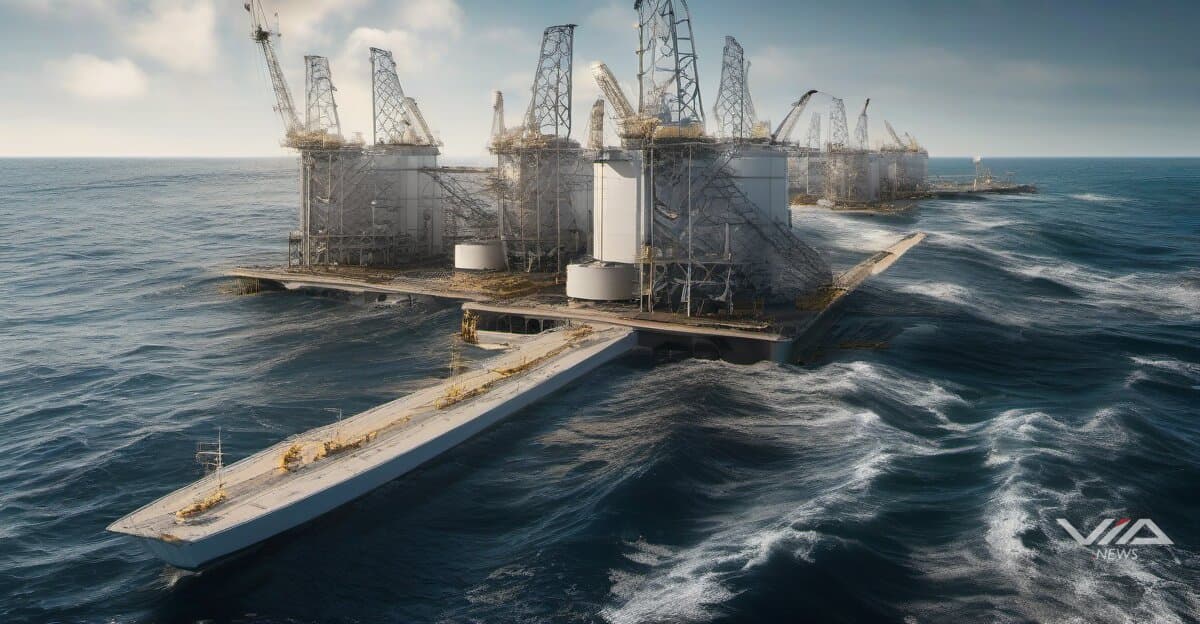
Image generated by AI for illustrative purposes. Not actual footage or photography from the reported events.
Loading stream...

Aikido is developing ocean-based data centers powered by offshore wind turbines to solve AI infrastructure power bottlenecks. The marine environment creates engineering challenges including increased salinity, debris, and metal pipe corrosion that don't exist in freshwater cooling systems, according to engineer Daniel King.

VCI Global launched V Gallant, a GPU-as-a-Service center in Malaysia targeting Southeast Asian AI businesses. Asia-Pacific ranks among the fastest-expanding regions for AI infrastructure deployment, with the facility addressing local demand for compute resources.

Ethernet Alliance released AI-specific networking protocols to handle increased data transfer requirements between GPUs and training clusters. Nokia accelerated AI-RAN partnerships for 6G networks, with executive Ronnie Vasishta stating physical AI requires intelligent networks "so operators can fully harness distributed intelligence across every layer."

Semiconductor equipment maker KLA projects mid-to-high teens growth in advanced packaging, the technology that connects multiple chips in AI accelerators. The forecast reflects manufacturing capacity expansion to meet AI hardware demand.

Veea Inc. open-sourced Lobster Trap, a security scanning tool for AI agents that operates under one millisecond with no meaningful delay. The company's TerraFabric platform sits above existing infrastructure as a coordination layer for edge deployments, working with Kubernetes and operating systems rather than replacing them.

The infrastructure buildout addresses three bottlenecks: power delivery for energy-intensive training workloads, network bandwidth between distributed compute nodes, and regional data center capacity in high-growth markets. Offshore facilities solve land and grid constraints but introduce saltwater engineering complexity. Regional hubs reduce latency for local AI workloads while advanced packaging increases chip density without new fabrication capacity.

Edge computing platforms are consolidating AI agent orchestration and security into unified systems. This shift enables enterprises to deploy autonomous systems without managing separate infrastructure layers for coordination, scanning, and execution.

Source documents

Via News is a conduit. We point to the source documents behind this report — we don't replace them. Trace any claim to its source and decide what to trust. How we source

Source Trace Score12 source documents12 with a live linkVerifiability: Strong
  1. [1]News articleYahoo Finance· February 27, 2026
    CPP Investments and Equinix to Acquire atNorth for US$4 Billion
  2. [2]News articleYahoo Finance· March 1, 2026
    Linux Foundation Announces OCUDU Ecosystem Foundation to Accelerate Open Source AI-RAN Innovation
  3. [3]Press releaseGlobeNewswire· March 1, 2026
    Nokia accelerates AI-RAN momentum with new partnerships driving path to AI-Native 6G #MWC26
  4. [4]News articleYahoo Finance· March 1, 2026
    NVIDIA and Global Telecom Leaders Commit to Build 6G on Open and Secure AI-Native Platforms
  5. [5]News articleIEEE Spectrum
    This Offshore Wind Turbine Will House a Data Center Underwater
  6. [6]News articleYahoo Finance· March 4, 2026
    Top Stock Reports for Berkshire Hathaway, KLA & CME
  7. [7]News articleYahoo Finance· March 4, 2026
    VCI Global’s V Gallant Launches Malaysia’s First NVIDIA-Powered AI GPU Computing Center; Debuts Intelli-X Enterprise LLM Platform
  8. [8]Press releaseGlobeNewswire· February 26, 2026
    Veea Inc. Launches TerraFabric, Paving the Way to Operate AI and Autonomous Systems at the Edge
  9. [9]Press releaseGlobeNewswire· March 2, 2026
    Veea Inc. Open-Sources Lobster Trap and Partners with NativelyAI to Advance Secure Agent Deployment
  10. [10]Press releaseGlobeNewswire· March 1, 2026
    Veea Platform Solution to Address Cybersecurity Challenges Nationwide for Businesses in Mexico
  11. [11]News articleYahoo Finance· February 24, 2026
    Agentic AI Foundation Welcomes 97 New Members As Demand for Open, Collaborative Agent Standardization Increases
  12. [12]News articleYahoo Finance· March 3, 2026
    AI-Scale Ethernet at the Heart of Ethernet Alliance’s OFC 2026 Demo

In this story

What we know · the intelligence behind this page
Live from the substrate
What we're seeing
AI Capital Surge Meets Investor Caution: Record Funding Rounds and Government Contracts Amid Valuation Skepticism
A single-week cluster of large AI/fintech funding rounds (Socure, Stability AI, Emerald AI, Generalist AI, Instinct, Gatik, Regent Craft) shows venture capital still pouring into AI infrastructure, identity, and autonomy plays, while Palantir's Army TITAN contract win coincided with a 6% stock drop — signaling that even flagship AI-defense revenue isn't immune to market reassessment of AI valuations. Efficiency-focused innovations like Multiverse Computing's model compression suggest the sector is also pivoting toward cost/inference economics as capital intensity draws scrutiny.
Our read on the data ›
Signals we're tracking
EPKINLY Regulatory-Clinical Success Cascade
High probability of expanded label indications, additional combination approvals, and competitive positioning strength in follicular lymphoma market. Predicts positive commercial uptake and potential accelerated review for related indications.
Patterns we're watching ›
Where sources disagree
Morgan Stanley & Co. LLC
The same metric (eps) for the same entity (Morgan Stanley & Co. LLC) reported for the identical fiscal period (Q1 2026) and observation date (2026-03-31) has two conflicting values: 3.43 USD_per_share vs 3.08 USD. This is not a temporal change — both observations claim to measure the same point in time. The ~10% discrepancy (0.35 USD difference) is material for a financial metric.
We flag conflicts openly ›
Recently verified
Checked against the original source
4,981
facts traced to their source — and we flag the ones that don't hold up.
101 entities tracked4,981 facts checked against source5,273 source documents archived
Query this data → isubstrate.com