
Saturday, September 5, 2026

Meta signs three nuclear deals as AI data centers race for reliable power

Meta secured three nuclear energy partnerships in January 2026 to power AI infrastructure, part of a broader shift as tech companies lock in stable electricity for training and inference workloads. The Trump administration launched an AI power deal initiative the same month, while DMG pursues partners for its Christina Lake AI data center and Westinghouse wins federal nuclear contracts.

Meta signs three nuclear deals as AI data centers race for reliable power
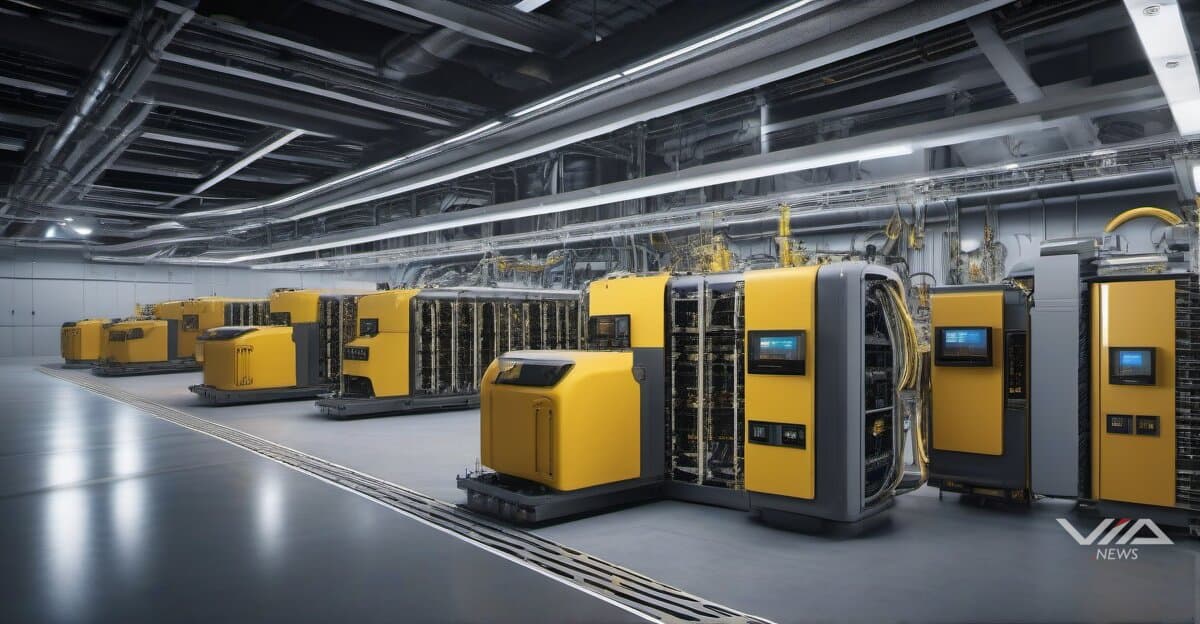
Image generated by AI for illustrative purposes. Not actual footage or photography from the reported events.
Loading stream...

Meta signed three nuclear energy deals on January 1, 2026, joining a push by AI companies to secure dedicated power for data centers running training and inference workloads.

The partnerships reflect infrastructure constraints as large language models demand stable electricity at scale. A single AI data center can consume 100+ megawatts—equivalent to powering 80,000 homes—making grid reliability critical for operators running 24/7 inference services.

The Trump administration announced an AI power deal initiative the same day, signaling policy support for pairing tech infrastructure with energy projects. DMG disclosed December 4, 2025 that it's pursuing partnerships for its Christina Lake AI data center development, following the pattern of co-locating compute facilities near dedicated power sources.

Westinghouse secured a U.S. government contract for nuclear reactor deployment, positioning suppliers to meet expected demand. GE Vernova raised long-term financial guidance on December 9, 2025, with stock performance since its IPO indicating investor confidence that energy infrastructure will capture value from AI buildout.

Nuclear power offers advantages over renewables for AI workloads: constant output regardless of weather, compact land footprint compared to solar farms, and no need for large-scale battery storage to handle intermittency. Data centers require uninterrupted power with minimal voltage fluctuation, making coal and gas alternatives less attractive amid decarbonization commitments by major tech firms.

The correlation between AI announcements and energy partnerships is measurable. Companies are allocating capital expenditures to power infrastructure at unprecedented rates, treating electricity access as a competitive moat rather than a commodity input.

Nuclear energy stocks have tracked AI infrastructure announcements over the past six months, with market participants pricing in sustained demand. The pattern suggests energy capacity, not chip supply, may become the binding constraint on AI deployment through 2027.

Tech companies face a choice: build near existing power sources, fund new generation capacity, or accept limitations on model scale and deployment speed. Meta's deals indicate the largest players are choosing dedicated infrastructure over grid dependence.

What we know · the intelligence behind this page
Live from the substrate
What we're seeing
AI Capital Surge Meets Investor Caution: Record Funding Rounds and Government Contracts Amid Valuation Skepticism
A single-week cluster of large AI/fintech funding rounds (Socure, Stability AI, Emerald AI, Generalist AI, Instinct, Gatik, Regent Craft) shows venture capital still pouring into AI infrastructure, identity, and autonomy plays, while Palantir's Army TITAN contract win coincided with a 6% stock drop — signaling that even flagship AI-defense revenue isn't immune to market reassessment of AI valuations. Efficiency-focused innovations like Multiverse Computing's model compression suggest the sector is also pivoting toward cost/inference economics as capital intensity draws scrutiny.
Our read on the data ›
Signals we're tracking
EPKINLY Regulatory-Clinical Success Cascade
High probability of expanded label indications, additional combination approvals, and competitive positioning strength in follicular lymphoma market. Predicts positive commercial uptake and potential accelerated review for related indications.
Patterns we're watching ›
Where sources disagree
Morgan Stanley & Co. LLC
The same metric (eps) for the same entity (Morgan Stanley & Co. LLC) reported for the identical fiscal period (Q1 2026) and observation date (2026-03-31) has two conflicting values: 3.43 USD_per_share vs 3.08 USD. This is not a temporal change — both observations claim to measure the same point in time. The ~10% discrepancy (0.35 USD difference) is material for a financial metric.
We flag conflicts openly ›
Recently verified
Checked against the original source
4,981
facts traced to their source — and we flag the ones that don't hold up.
101 entities tracked4,981 facts checked against source5,273 source documents archived
Query this data → isubstrate.com