
Sunday, September 6, 2026

US Halts Nvidia H200 Chip Exports to China as New GPU Permit System Looms

The US government has stopped Nvidia H200 shipments to China and is developing new GPU export licensing requirements. The controls are disrupting AI hardware supply chains while defense partnerships face internal pushback, including OpenAI's robotics leader resigning over Pentagon deals and Anthropic's Pentagon negotiations despite being flagged as a supply chain risk.

US Halts Nvidia H200 Chip Exports to China as New GPU Permit System Looms
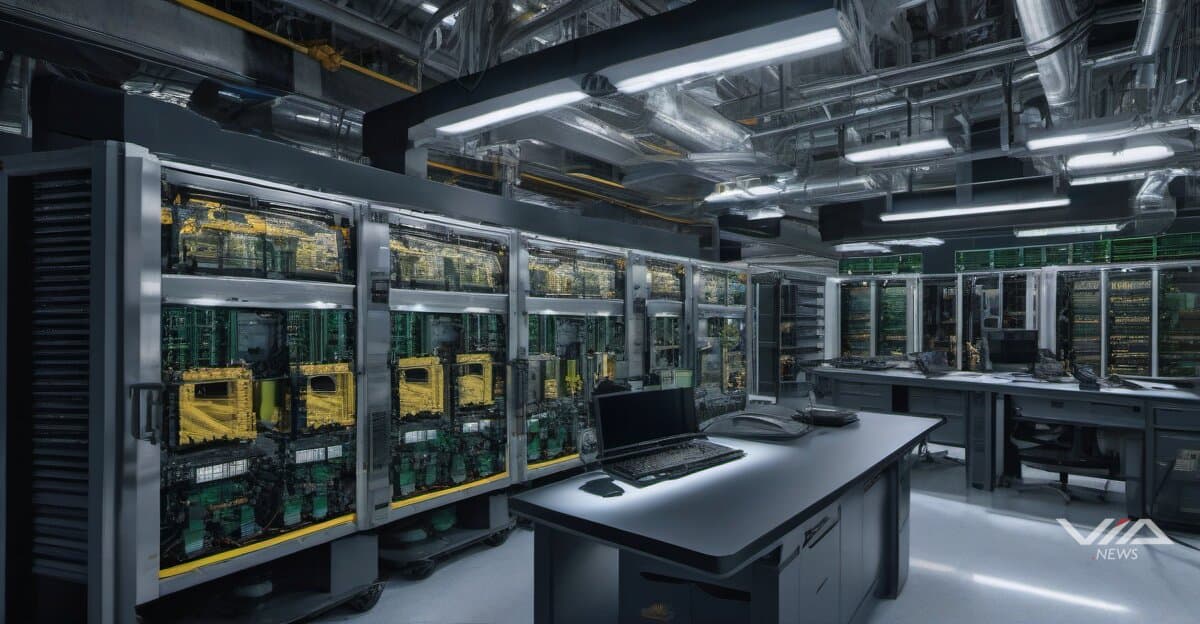
Image generated by AI for illustrative purposes. Not actual footage or photography from the reported events.
Loading stream...

Nvidia's H200 GPU shipments to China have been halted by US export controls, with the government preparing a new permitting process for high-performance AI chips. The restrictions target advanced AI hardware amid escalating national security concerns over China's access to cutting-edge computing capabilities.

The export controls are reshaping procurement timelines for AI companies and research institutions globally. Hardware buyers face uncertainty as the US considers expanding licensing requirements beyond current thresholds, potentially affecting data center buildouts and AI development schedules across multiple markets.

Nvidia's H200, featuring 141GB HBM3e memory and significantly faster performance than the H100, represents the latest generation of AI training hardware now subject to geographic restrictions. The chip's blocked exports compound existing supply constraints as AI labs compete for limited GPU allocations.

Defense sector AI partnerships are encountering resistance alongside the export restrictions. OpenAI's robotics division leader resigned over the company's Pentagon contracts, highlighting internal tensions as AI firms balance commercial growth with military applications. The departure signals employee concerns about autonomous systems development for defense purposes.

Anthropic has been designated a supply chain risk by federal evaluators while simultaneously pursuing renewed Pentagon negotiations. This dual status reflects the complex regulatory landscape AI companies navigate, where national security classifications can shift even as government partnerships expand.

The combined regulatory pressure affects hardware availability across the AI ecosystem. Research institutions dependent on the latest GPUs face procurement delays, while AI startups encounter extended lead times for compute infrastructure. Cloud providers must adjust capacity planning around export compliance requirements.

Alternative hardware markets are emerging as Chinese AI companies seek non-US chip sources. Domestic Chinese semiconductor manufacturers are accelerating AI accelerator development, though performance gaps with Nvidia's latest offerings remain substantial. The export controls are accelerating fragmentation in the global AI hardware supply chain.

The regulatory intervention comes as AI compute demand reaches unprecedented levels. Training frontier models requires thousands of interconnected GPUs, making export restrictions particularly impactful for large-scale AI development programs. Hardware access is becoming a key competitive differentiator in AI capabilities.

Source documents

Via News is a conduit. We point to the source documents behind this report — we don't replace them. Trace any claim to its source and decide what to trust. How we source

Source Trace Score1 source document1 with a live linkVerifiability: Basic
  1. [1]News articleYahoo Finance· March 9, 2026
    Tech stocks today: OpenAI's robotics leader resigns after Pentagon deal, Anthropic prepares to battle ban

In this story

What we know · the intelligence behind this page
Live from the substrate
What we're seeing
AI Capital Surge Meets Investor Caution: Record Funding Rounds and Government Contracts Amid Valuation Skepticism
A single-week cluster of large AI/fintech funding rounds (Socure, Stability AI, Emerald AI, Generalist AI, Instinct, Gatik, Regent Craft) shows venture capital still pouring into AI infrastructure, identity, and autonomy plays, while Palantir's Army TITAN contract win coincided with a 6% stock drop — signaling that even flagship AI-defense revenue isn't immune to market reassessment of AI valuations. Efficiency-focused innovations like Multiverse Computing's model compression suggest the sector is also pivoting toward cost/inference economics as capital intensity draws scrutiny.
Our read on the data ›
Signals we're tracking
EPKINLY Regulatory-Clinical Success Cascade
High probability of expanded label indications, additional combination approvals, and competitive positioning strength in follicular lymphoma market. Predicts positive commercial uptake and potential accelerated review for related indications.
Patterns we're watching ›
Where sources disagree
Morgan Stanley & Co. LLC
The same metric (eps) for the same entity (Morgan Stanley & Co. LLC) reported for the identical fiscal period (Q1 2026) and observation date (2026-03-31) has two conflicting values: 3.43 USD_per_share vs 3.08 USD. This is not a temporal change — both observations claim to measure the same point in time. The ~10% discrepancy (0.35 USD difference) is material for a financial metric.
We flag conflicts openly ›
Recently verified
Checked against the original source
4,981
facts traced to their source — and we flag the ones that don't hold up.
101 entities tracked4,981 facts checked against source5,273 source documents archived
Query this data → isubstrate.com