
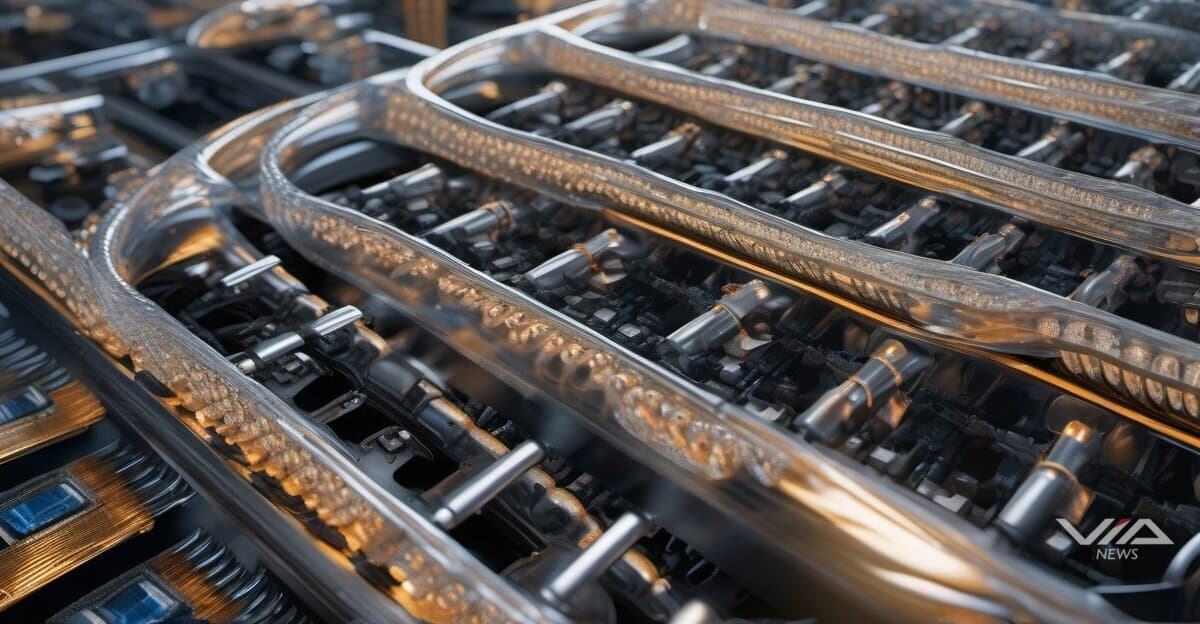
The artificial intelligence infrastructure buildout is doing more than filling data centers with GPUs — it is fundamentally rewiring the entire semiconductor supply chain, from the chips themselves down to how they are packaged, timed, and connected.
Nowhere is this more visible than in advanced chip packaging. Amkor Technology, the world's largest U.S.-headquartered outsourced semiconductor assembly and test (OSAT) provider, sits at the center of this shift. As AI accelerators grow ever more complex — stacking memory, logic, and specialized compute dies into single multi-chip modules — the packaging layer has transformed from a commodity afterthought into a strategic bottleneck. Amkor's global leadership in this space positions it as a critical enabler of the next generation of AI silicon, where the packaging itself can determine whether a chip meets its performance and power targets.
The ripple effects extend well beyond packaging. SiTime Corporation recently announced its acquisition of Renesas's timing business, a move the company projects will be accretive to non-GAAP earnings per share in the first year after closing. Precision timing is rarely discussed in mainstream AI coverage, but it is foundational: as AI clusters scale to thousands of interconnected accelerators, synchronization across the fabric becomes a hard engineering constraint. SiTime's consolidation play signals that timing specialists see a long runway of infrastructure-driven demand ahead.
On the networking side, Cisco's Silicon One G300 announcement underscores a parallel theme. "AI at scale demands open, standards-based networking that customers can deploy with confidence across diverse environments," said Yousuf Khan, articulating the industry's growing consensus that proprietary networking architectures cannot scale alongside the open, heterogeneous AI stacks that hyperscalers and enterprises are building. Silicon purpose-built for AI fabric is becoming its own category.
Meanwhile, legacy semiconductor players are using the AI transition as cover for necessary restructuring. ams OSRAM is aggressively divesting non-core assets and debt while pivoting toward high-growth verticals including automotive Digital Light and AR/VR applications. The company has already secured more than EUR 500 million in design wins for its Digital Light technology — a signal that even non-AI-native semiconductor businesses are reconfiguring around the compute megatrend's adjacencies.
Cirrus Logic, a specialist in mixed-signal chips, is guiding for Q4 fiscal 2026 GAAP gross margins between 51 and 53 percent, reflecting the pricing power that accrues to suppliers of differentiated, hard-to-replicate components in a demand-constrained environment.
The broader picture is one of simultaneous expansion and consolidation. Capital is flowing toward specialists who can solve specific bottlenecks in the AI infrastructure stack — whether that is advanced packaging yield, sub-nanosecond timing precision, or high-bandwidth open networking. At the same time, companies unable to credibly articulate an AI-adjacent roadmap are under pressure to restructure or divest.
Complicating the outlook are macro and geopolitical crosscurrents: dollar weakness, ongoing U.S. trade policy volatility, and Chinese AI acceleration are all introducing valuation uncertainty even as strategic design wins and long-horizon capital commitments reflect genuine industry conviction. The semiconductor supply chain is being rebuilt in real time — and AI infrastructure demand is holding the blueprints.