
Saturday, September 5, 2026

AMD wins double-digit billion dollar Meta data center contract as AI infrastructure costs pressure hyperscalers

Meta awarded AMD a data center GPU contract worth billions per gigawatt, driving AMD stock up 7% as hyperscalers seek cost alternatives to NVIDIA. The deal marks a potential shift in the AI hardware market as companies balance performance against trillion-dollar infrastructure buildouts.

AMD wins double-digit billion dollar Meta data center contract as AI infrastructure costs pressure hyperscalers
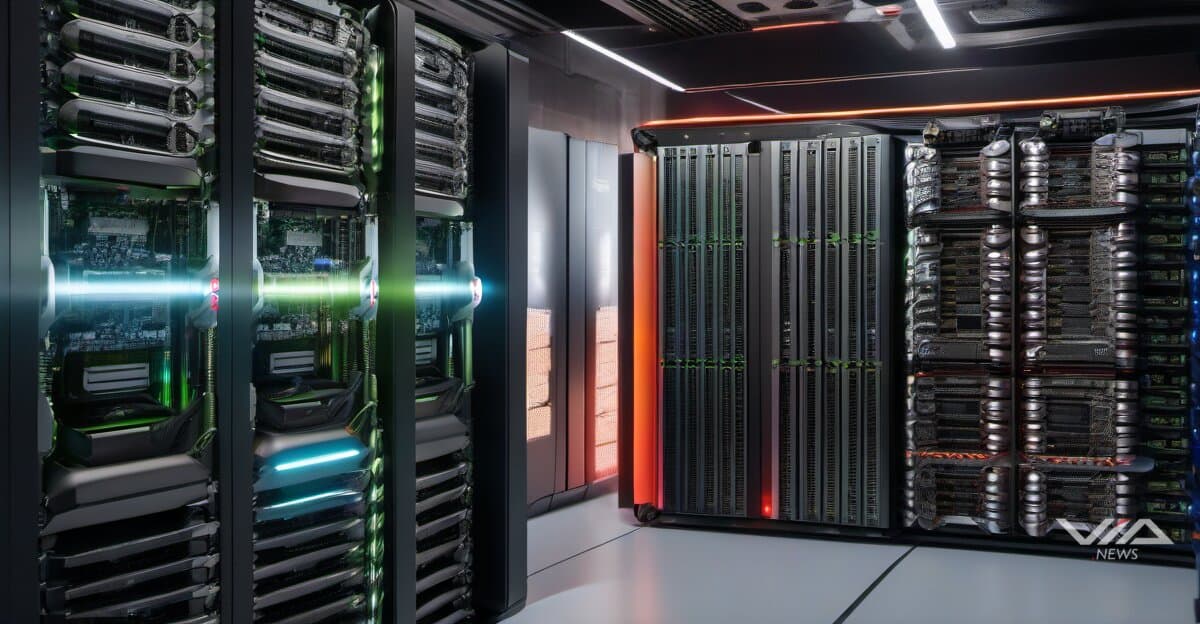
Image generated by AI for illustrative purposes. Not actual footage or photography from the reported events.
Loading stream...

Meta awarded AMD a data center contract worth double-digit billions of dollars per gigawatt, sending AMD stock up 7% on the announcement. The deal represents one of the largest hyperscaler GPU contracts for AMD as cloud providers look beyond NVIDIA to manage AI infrastructure costs.

Netris reports AI infrastructure represents the largest buildout in human history, with trillions in investment required. This scale is pushing hyperscalers to optimize costs without sacrificing capability, creating openings for AMD's data center GPUs.

The Meta contract signals growing acceptance of AMD alternatives in production AI workloads. Previous data center GPU sales were dominated by NVIDIA, which holds roughly 80-90% market share in AI accelerators. AMD's pricing advantage—typically 20-30% lower than comparable NVIDIA offerings—becomes more compelling at Meta's deployment scale.

VCI Global Limited notes the Asia-Pacific region ranks among the fastest-expanding markets for AI infrastructure. This geographic expansion multiplies the total addressable market, allowing AMD to capture growth even while NVIDIA maintains overall leadership.

AMD's data center GPU revenue will serve as the key metric for validating this shift. Analysts expect the next 2-3 quarters to show whether Meta's contract represents an isolated win or the start of broader hyperscaler diversification. Additional contract announcements from AWS, Google Cloud, or Microsoft Azure would confirm the trend.

The competitive pressure benefits AI developers through lower training and inference costs. Every percentage point AMD captures from NVIDIA creates pricing pressure across the market. For companies building AI products, reduced infrastructure costs directly improve unit economics.

Win rates in upcoming hyperscaler RFPs will determine whether AMD's 7% stock jump reflects genuine market share gains or a temporary spike. The Meta contract proves AMD can compete on price at scale. Whether they can match NVIDIA on performance, software ecosystem, and supply remains the open question.

In this story

What we know · the intelligence behind this page
Live from the substrate
What we're seeing
AI Capital Surge Meets Investor Caution: Record Funding Rounds and Government Contracts Amid Valuation Skepticism
A single-week cluster of large AI/fintech funding rounds (Socure, Stability AI, Emerald AI, Generalist AI, Instinct, Gatik, Regent Craft) shows venture capital still pouring into AI infrastructure, identity, and autonomy plays, while Palantir's Army TITAN contract win coincided with a 6% stock drop — signaling that even flagship AI-defense revenue isn't immune to market reassessment of AI valuations. Efficiency-focused innovations like Multiverse Computing's model compression suggest the sector is also pivoting toward cost/inference economics as capital intensity draws scrutiny.
Our read on the data ›
Signals we're tracking
EPKINLY Regulatory-Clinical Success Cascade
High probability of expanded label indications, additional combination approvals, and competitive positioning strength in follicular lymphoma market. Predicts positive commercial uptake and potential accelerated review for related indications.
Patterns we're watching ›
Where sources disagree
Morgan Stanley & Co. LLC
The same metric (eps) for the same entity (Morgan Stanley & Co. LLC) reported for the identical fiscal period (Q1 2026) and observation date (2026-03-31) has two conflicting values: 3.43 USD_per_share vs 3.08 USD. This is not a temporal change — both observations claim to measure the same point in time. The ~10% discrepancy (0.35 USD difference) is material for a financial metric.
We flag conflicts openly ›
Recently verified
Checked against the original source
4,981
facts traced to their source — and we flag the ones that don't hold up.
101 entities tracked4,981 facts checked against source5,273 source documents archived
Query this data → isubstrate.com