
Saturday, September 5, 2026

Micron's 2026 HBM Output Is Fully Sold Out

Micron says its entire High Bandwidth Memory production for 2026 has already been sold, signaling AI accelerator demand is outrunning memory supply. The sellout comes as Sanjay Mehrotra leads Micron through the AI-driven memory upcycle, positioning HBM as a chokepoint for AI chip scaling.

LM Salvado

July 3, 2026

Micron's 2026 HBM Output Is Fully Sold Out
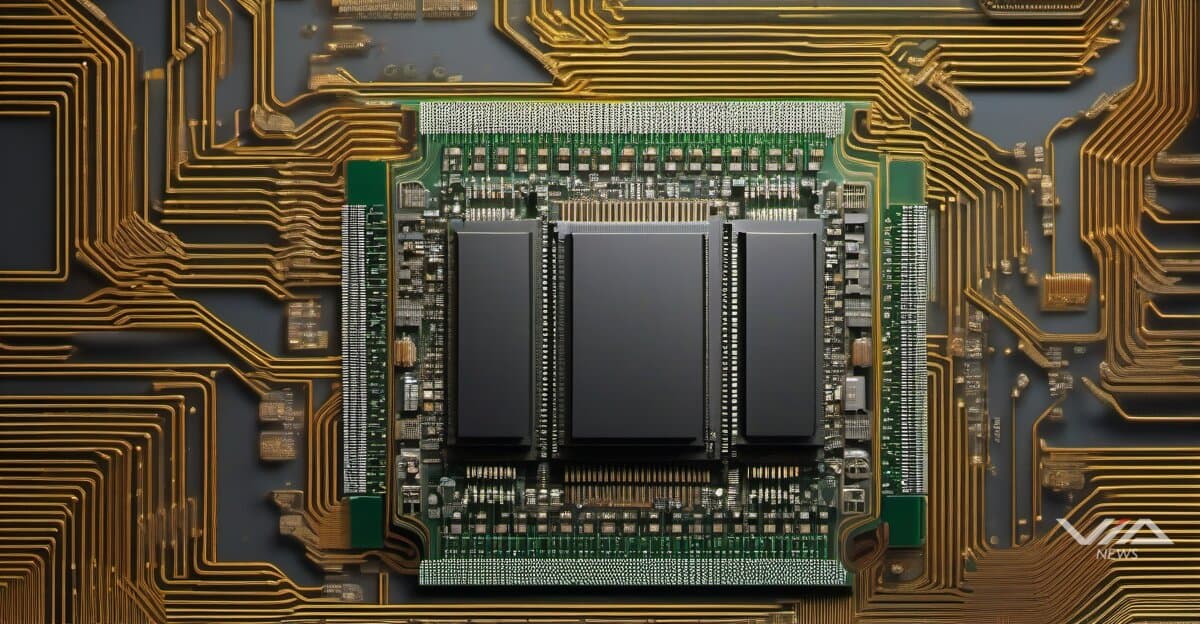
Image generated by AI for illustrative purposes. Not actual footage or photography from the reported events.
Loading stream...

Micron's High Bandwidth Memory output for 2026 is completely sold out, the company says.1 HBM chips stack memory directly next to AI accelerators, feeding data to processors like Nvidia's GPUs faster than standard DRAM.

A full sellout more than a year ahead of production means buyers are locking in supply before it exists. That points to AI accelerator demand outpacing memory manufacturers' ability to build capacity.1

Micron CEO Sanjay Mehrotra is steering the company through this demand surge.2 HBM has become a structural bottleneck in AI hardware: chipmakers can design faster processors, but those chips are useless without enough high-speed memory to feed them.

The sellout suggests Micron's HBM segment could grow faster than its overall DRAM business in coming quarters. If HBM revenue and margins expand faster than the rest of Micron's memory portfolio, it would confirm AI accelerator buyers are paying a premium to secure scarce supply.

Analysts tracking the company will watch Micron's next two to three quarterly earnings reports for HBM segment revenue growth and gross margin expansion relative to prior guidance.1 A widening gap between HBM growth and total DRAM growth would confirm memory, not chip design, is now the binding constraint on AI accelerator output.

The dynamic matters beyond Micron. If HBM supply is committed through 2026, competitors racing to ship AI chips - and cloud providers racing to deploy them - face a shared ceiling on how fast they can scale, regardless of processor availability.

In this story

About this analysis

This is a Via News analysis. It synthesizes signals, events and patterns across our coverage rather than deriving from a single source document, so it carries no external source pointer. Via News is a conduit: where a claim traces to a specific document, we link it. How we source

LM Salvado

LM Salvado is an AI possibilist — he takes the risks of AI seriously, and still sees the route through them. Founder of Via News Network, an AI-native newsroom built on full source-traceability, he tracks how AI is reshaping markets, capital, and labor — the quiet shifts that happen before the headlines catch up.

What we know · the intelligence behind this page
Live from the substrate
What we're seeing
AI Capital Surge Meets Investor Caution: Record Funding Rounds and Government Contracts Amid Valuation Skepticism
A single-week cluster of large AI/fintech funding rounds (Socure, Stability AI, Emerald AI, Generalist AI, Instinct, Gatik, Regent Craft) shows venture capital still pouring into AI infrastructure, identity, and autonomy plays, while Palantir's Army TITAN contract win coincided with a 6% stock drop — signaling that even flagship AI-defense revenue isn't immune to market reassessment of AI valuations. Efficiency-focused innovations like Multiverse Computing's model compression suggest the sector is also pivoting toward cost/inference economics as capital intensity draws scrutiny.
Our read on the data ›
Signals we're tracking
EPKINLY Regulatory-Clinical Success Cascade
High probability of expanded label indications, additional combination approvals, and competitive positioning strength in follicular lymphoma market. Predicts positive commercial uptake and potential accelerated review for related indications.
Patterns we're watching ›
Where sources disagree
Morgan Stanley & Co. LLC
The same metric (eps) for the same entity (Morgan Stanley & Co. LLC) reported for the identical fiscal period (Q1 2026) and observation date (2026-03-31) has two conflicting values: 3.43 USD_per_share vs 3.08 USD. This is not a temporal change — both observations claim to measure the same point in time. The ~10% discrepancy (0.35 USD difference) is material for a financial metric.
We flag conflicts openly ›
Recently verified
Checked against the original source
4,981
facts traced to their source — and we flag the ones that don't hold up.
101 entities tracked4,981 facts checked against source5,273 source documents archived
Query this data → isubstrate.com