
Saturday, September 5, 2026

Photonics Shortage Chokes AI Infrastructure as Lumentum Ships 30% Below Demand

AI datacenter construction is hitting critical supply constraints in photonics components, with Lumentum undershipping demand by 30% and its order backlog exceeding $400 million. All electroabsorption-modulated laser (EML) manufacturing capacity is locked in contracts through late 2027, creating multi-year revenue visibility for specialized suppliers.

Photonics Shortage Chokes AI Infrastructure as Lumentum Ships 30% Below Demand
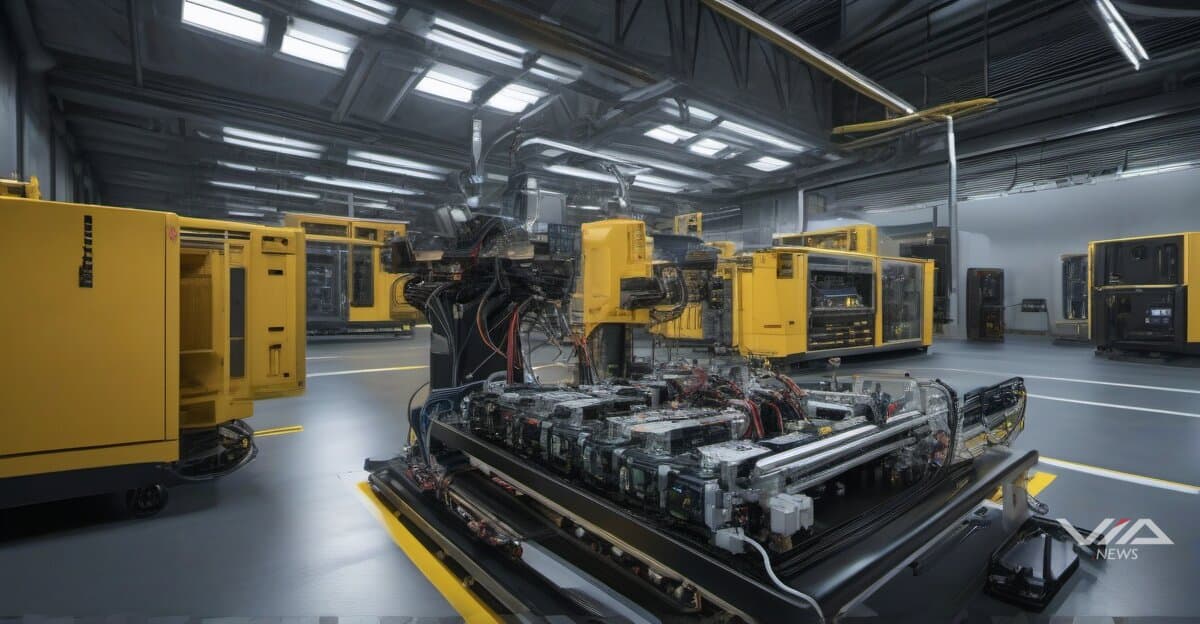
Image generated by AI for illustrative purposes. Not actual footage or photography from the reported events.
Loading stream...

Lumentum is shipping 30% less than customer orders for photonics components essential to AI datacenter networks. The company's optical communications systems (OCS) backlog has surged past $400 million, with most units scheduled for second-half delivery.

All EML production capacity is committed through the end of calendar 2027 under long-term supply agreements. Lumentum increased its indium phosphide manufacturing capacity by over 20% in the December quarter alone, with plans for further expansion. Despite these additions, the demand-supply gap continues widening.

EML chips convert electrical signals to optical light in AI datacenter transceivers, enabling high-speed data transfer between GPUs and servers. The components use indium phosphide wafers requiring specialized fabrication processes that take 18-24 months to scale.

Lumentum's position as a foundational supplier to virtually every AI network gives the shortage systemic implications. Hyperscalers including Microsoft, Google, and Meta are building clusters requiring hundreds of thousands of optical transceivers per facility. Each next-generation AI training cluster needs 10-15x more optical interconnect bandwidth than previous server generations.

The photonics bottleneck compounds GPU supply constraints that have dominated AI infrastructure headlines. Even companies securing Nvidia H100 or B200 chips face delays networking them into functional training clusters without adequate optical components.

Coherent Corp, II-VI, and other photonics manufacturers report similar capacity constraints. The specialized nature of indium phosphide fabrication creates high barriers to new entrants, limiting near-term relief. Traditional silicon photonics offer lower performance for AI workloads requiring 800G and 1.6T transmission speeds.

Long-term supply agreements extending through 2027 give photonics makers unprecedented revenue visibility but leave AI infrastructure buyers scrambling for allocation. Some hyperscalers are pursuing captive photonics capabilities, though developing competitive manufacturing takes years.

The shortage will likely constrain AI training capacity expansion through at least 2026, potentially creating a new chokepoint independent of GPU availability. Datacenter operators report optical components now consume 15-20% of total infrastructure budgets, up from 8-10% two years ago.

In this story

What we know · the intelligence behind this page
Live from the substrate
What we're seeing
AI Capital Surge Meets Investor Caution: Record Funding Rounds and Government Contracts Amid Valuation Skepticism
A single-week cluster of large AI/fintech funding rounds (Socure, Stability AI, Emerald AI, Generalist AI, Instinct, Gatik, Regent Craft) shows venture capital still pouring into AI infrastructure, identity, and autonomy plays, while Palantir's Army TITAN contract win coincided with a 6% stock drop — signaling that even flagship AI-defense revenue isn't immune to market reassessment of AI valuations. Efficiency-focused innovations like Multiverse Computing's model compression suggest the sector is also pivoting toward cost/inference economics as capital intensity draws scrutiny.
Our read on the data ›
Signals we're tracking
EPKINLY Regulatory-Clinical Success Cascade
High probability of expanded label indications, additional combination approvals, and competitive positioning strength in follicular lymphoma market. Predicts positive commercial uptake and potential accelerated review for related indications.
Patterns we're watching ›
Where sources disagree
Morgan Stanley & Co. LLC
The same metric (eps) for the same entity (Morgan Stanley & Co. LLC) reported for the identical fiscal period (Q1 2026) and observation date (2026-03-31) has two conflicting values: 3.43 USD_per_share vs 3.08 USD. This is not a temporal change — both observations claim to measure the same point in time. The ~10% discrepancy (0.35 USD difference) is material for a financial metric.
We flag conflicts openly ›
Recently verified
Checked against the original source
4,981
facts traced to their source — and we flag the ones that don't hold up.
101 entities tracked4,981 facts checked against source5,273 source documents archived
Query this data → isubstrate.com