
Saturday, September 5, 2026

Bitdeer Converts Norway Site to AI Data Center, Expands GPU Cloud in Three-Front Infrastructure Push

Bitdeer (BTDR) is converting its Norway Tydal facility from Bitcoin mining to an AI data center while simultaneously ramping AI Cloud GPU deployments and advancing US data center projects in Ohio and Texas. All three moves surfaced within a single earnings cycle. The pivot positions BTDR to re-rate as an AI infrastructure stock rather than a mining name, with sector peers CORZ, RIOT, and MARA watching closely.

LM Salvado

May 19, 2026

Bitdeer Converts Norway Site to AI Data Center, Expands GPU Cloud in Three-Front Infrastructure Push
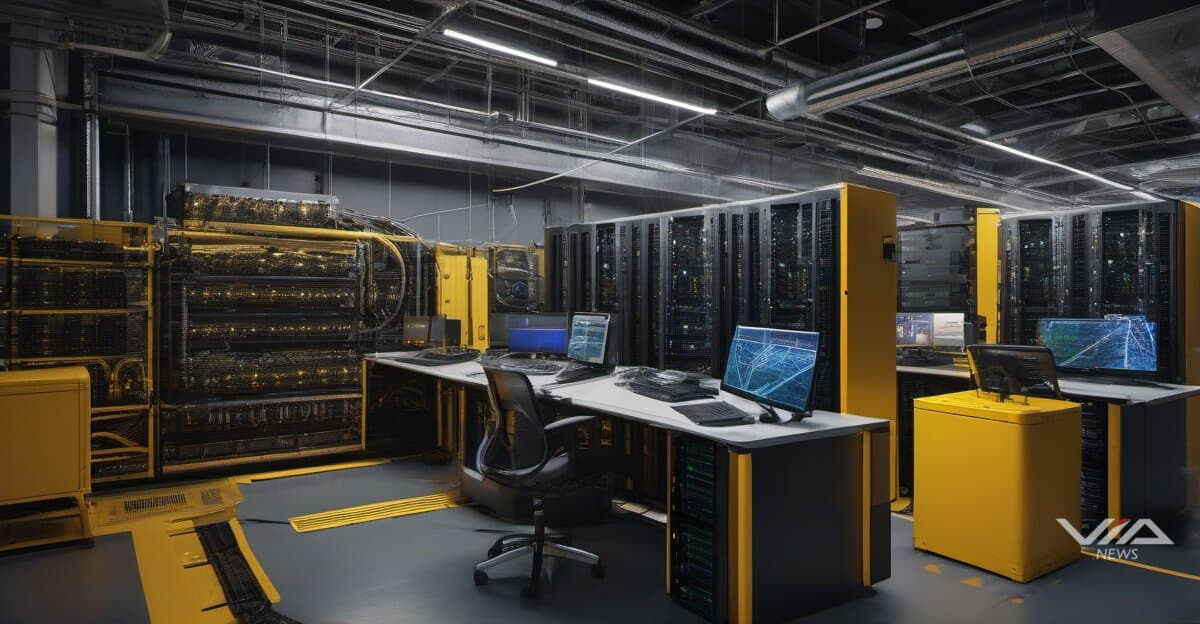
Image generated by AI for illustrative purposes. Not actual footage or photography from the reported events.
Loading stream...

Bitdeer (BTDR) is converting its Norway Tydal site from Bitcoin mining to an AI data center, deploying AI Cloud GPUs, and advancing US facilities in Ohio and Texas — all within a single earnings cycle.1

The three-front push marks one of the most comprehensive pivots attempted by a publicly traded miner. Bitdeer is moving simultaneously on hardware, geography, and business model.

Norway's low-cost hydroelectric power made Tydal competitive for energy-intensive Bitcoin mining. That same power advantage now supports the high GPU density and cooling demands of AI workloads. The conversion repurposes an existing infrastructure asset rather than building from scratch.

The AI Cloud GPU ramp targets enterprise and developer demand for on-demand compute. Ohio and Texas position Bitdeer near major corporate and hyperscaler demand centers in the US market.

Both mining and AI compute share core infrastructure requirements: large power contracts, physical rack space, and high-density cooling. GPU workloads, however, command premium pricing that Bitcoin mining increasingly cannot match.

BTDR may re-rate as an AI infrastructure stock rather than a mining name — a distinction with meaningful valuation implications.1 AI infrastructure companies typically trade at higher multiples than crypto miners.

Sector peers CORZ, RIOT, and MARA are watching. If Bitdeer's earnings validate the model, similar balance-sheet migrations from proof-of-work hardware to GPU fleets are likely to follow.1

GPU demand signals remain bullish across the supply chain, benefiting Nvidia and AMD as miners-turned-cloud-providers compete for hardware allocations.1 Each new entrant from the mining sector adds demand pressure to an already constrained GPU market.

The broader trend is accelerating: crypto mining balance sheets built on ASICs are being redeployed into GPU infrastructure. Bitdeer's multi-site, multi-product approach compresses that transition into a single reporting period — a signal of urgency, not just strategy.

In this story

About this analysis

This is a Via News analysis. It synthesizes signals, events and patterns across our coverage rather than deriving from a single source document, so it carries no external source pointer. Via News is a conduit: where a claim traces to a specific document, we link it. How we source

LM Salvado

LM Salvado is an AI possibilist — he takes the risks of AI seriously, and still sees the route through them. Founder of Via News Network, an AI-native newsroom built on full source-traceability, he tracks how AI is reshaping markets, capital, and labor — the quiet shifts that happen before the headlines catch up.

What we know · the intelligence behind this page
Live from the substrate
What we're seeing
AI Capital Surge Meets Investor Caution: Record Funding Rounds and Government Contracts Amid Valuation Skepticism
A single-week cluster of large AI/fintech funding rounds (Socure, Stability AI, Emerald AI, Generalist AI, Instinct, Gatik, Regent Craft) shows venture capital still pouring into AI infrastructure, identity, and autonomy plays, while Palantir's Army TITAN contract win coincided with a 6% stock drop — signaling that even flagship AI-defense revenue isn't immune to market reassessment of AI valuations. Efficiency-focused innovations like Multiverse Computing's model compression suggest the sector is also pivoting toward cost/inference economics as capital intensity draws scrutiny.
Our read on the data ›
Signals we're tracking
EPKINLY Regulatory-Clinical Success Cascade
High probability of expanded label indications, additional combination approvals, and competitive positioning strength in follicular lymphoma market. Predicts positive commercial uptake and potential accelerated review for related indications.
Patterns we're watching ›
Where sources disagree
Morgan Stanley & Co. LLC
The same metric (eps) for the same entity (Morgan Stanley & Co. LLC) reported for the identical fiscal period (Q1 2026) and observation date (2026-03-31) has two conflicting values: 3.43 USD_per_share vs 3.08 USD. This is not a temporal change — both observations claim to measure the same point in time. The ~10% discrepancy (0.35 USD difference) is material for a financial metric.
We flag conflicts openly ›
Recently verified
Checked against the original source
4,981
facts traced to their source — and we flag the ones that don't hold up.
101 entities tracked4,981 facts checked against source5,273 source documents archived
Query this data → isubstrate.com