
Saturday, September 5, 2026

Pentagon Bans Claude AI as Foundation Models Face Military Entanglement and Power Concentration

The Pentagon banned Anthropic's Claude AI while foundation models increasingly face military applications and government restrictions. Arthur Mensch of Mistral argues open systems counter power concentration as India invests billions in AI sovereignty. Lawsuits over AI safety failures signal mounting tensions between capabilities and accountability.

Pentagon Bans Claude AI as Foundation Models Face Military Entanglement and Power Concentration
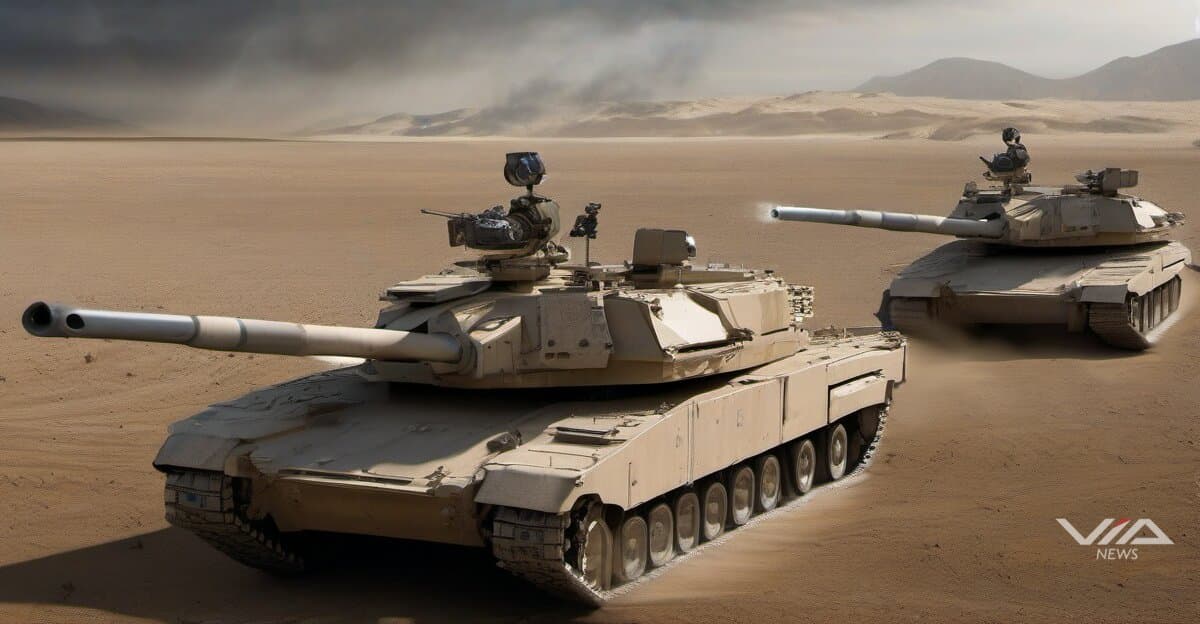
Image generated by AI for illustrative purposes. Not actual footage or photography from the reported events.
Loading stream...

The Pentagon banned Anthropic's Claude AI from use in military operations, marking the first major restriction on foundation models by the U.S. Department of Defense. The decision follows leaked internal memos from Anthropic raising concerns about military applications of AI systems.

Mistral CEO Arthur Mensch stated the AI supremacy fight centers on open versus closed systems, not geographic location. "Power concentration in AI development poses greater risks than where systems are built," Mensch said, advocating for open-source models to distribute control.

India launched a $15 billion initiative to develop sovereign AI capabilities, joining a global race where nations seek independence from U.S. and Chinese foundation models. The investment targets domestic model development and computing infrastructure.

Lawsuits against AI companies over safety failures increased 340% in 2025, according to legal filings. Cases cite inadequate testing, harmful outputs, and lack of accountability mechanisms in deployed systems. Courts now examine whether foundation model developers bear liability for downstream applications.

The Anthropic memo controversy revealed internal debates about accepting military contracts. Staff members questioned whether Constitutional AI safeguards sufficiently prevent weapons development applications. The company declined comment on specific Pentagon discussions.

Foundation models now power military reconnaissance in seven countries, defense analysts confirmed. Applications include satellite imagery analysis, logistics optimization, and strategic planning. None currently make autonomous weapons decisions, per international law.

Geopolitical tensions escalated after the U.S. restricted GPU exports to 23 countries, citing AI weapons proliferation risks. China responded with rare earth mineral export controls critical for chip manufacturing. The European Union proposed AI sovereignty requirements for government contracts.

Three major AI labs now employ former defense officials in leadership roles, raising concerns about revolving door dynamics. Transparency advocates demanded disclosure of military partnerships and dual-use research.

The crisis highlights fundamental questions about who controls transformative AI systems. As capabilities advance, the gap between technical progress and governance frameworks widens. International AI safety summits scheduled for April aim to address coordination mechanisms, though binding agreements remain unlikely.

Source documents

Via News is a conduit. We point to the source documents behind this report — we don't replace them. Trace any claim to its source and decide what to trust. How we source

Source Trace Score10 source documents10 with a live linkVerifiability: Strong
  1. [1]News articleYahoo Finance· February 20, 2026
    Modi’s Chaotic AI Summit Showed India’s Clout and Constraints
  2. [2]Press releaseGlobeNewswire· February 27, 2026
    Telix Joins Forces with University Hospital Essen on PROMISE-PET: Optimizing Patient Management through AI-enabled PSMA-PET Imaging
  3. [3]News articleMIT Technology Review
    The Download: a blockchain enigma, and the algorithms governing our lives
  4. [4]News articleMIT Technology Review
    The Download: autonomous narco submarines, and virtue signaling chatbots
  5. [5]News articleMIT Technology Review
    The Download: Earth’s rumblings, and AI for strikes on Iran
  6. [6]News articleMIT Technology Review
    The Download: the rise of luxury car theft, and fighting antimicrobial resistance
  7. [7]News articleMIT Technology Review
    The Download: 10 things that matter in AI, plus Anthropic’s plan to sue the Pentagon
  8. [8]News articleMIT Technology Review
    The Download: an AI agent’s hit piece, and preventing lightning
  9. [9]News articleIEEE Spectrum
    Video Friday: Autonomous Robots Learn By Doing in This Factory
  10. [10]News articleIEEE Spectrum
    Video Friday: Robot Collective Stays Alive Even When Parts Die

In this story

What we know · the intelligence behind this page
Live from the substrate
What we're seeing
AI Capital Surge Meets Investor Caution: Record Funding Rounds and Government Contracts Amid Valuation Skepticism
A single-week cluster of large AI/fintech funding rounds (Socure, Stability AI, Emerald AI, Generalist AI, Instinct, Gatik, Regent Craft) shows venture capital still pouring into AI infrastructure, identity, and autonomy plays, while Palantir's Army TITAN contract win coincided with a 6% stock drop — signaling that even flagship AI-defense revenue isn't immune to market reassessment of AI valuations. Efficiency-focused innovations like Multiverse Computing's model compression suggest the sector is also pivoting toward cost/inference economics as capital intensity draws scrutiny.
Our read on the data ›
Signals we're tracking
EPKINLY Regulatory-Clinical Success Cascade
High probability of expanded label indications, additional combination approvals, and competitive positioning strength in follicular lymphoma market. Predicts positive commercial uptake and potential accelerated review for related indications.
Patterns we're watching ›
Where sources disagree
Morgan Stanley & Co. LLC
The same metric (eps) for the same entity (Morgan Stanley & Co. LLC) reported for the identical fiscal period (Q1 2026) and observation date (2026-03-31) has two conflicting values: 3.43 USD_per_share vs 3.08 USD. This is not a temporal change — both observations claim to measure the same point in time. The ~10% discrepancy (0.35 USD difference) is material for a financial metric.
We flag conflicts openly ›
Recently verified
Checked against the original source
4,981
facts traced to their source — and we flag the ones that don't hold up.
101 entities tracked4,981 facts checked against source5,273 source documents archived
Query this data → isubstrate.com