
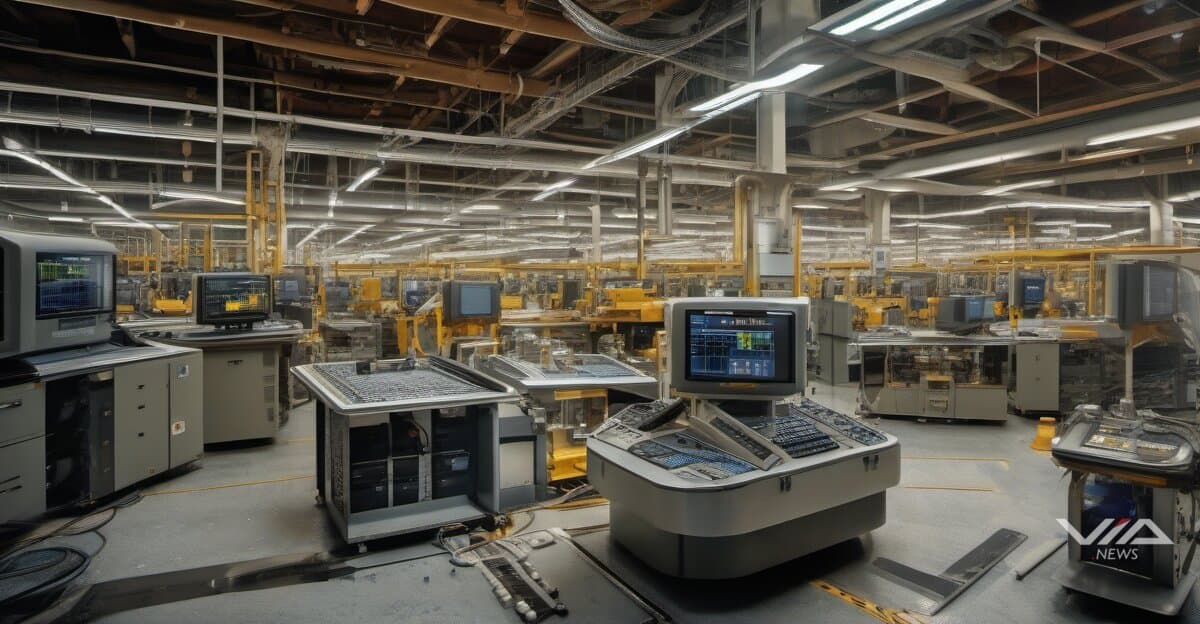
The constraint in AI hardware is supply, not demand
The most useful sentence in this earnings season for anyone tracking AI infrastructure came from a chip-equipment maker's finance chief, not a model lab. Lam Research CFO Douglas Bettinger said the company's revenue guide "would have been a bit higher, if not for some near-term supply chain constraints that we are actively managing."1 Lam makes the machines used to build chips. Its customers include hyperscalers, the large cloud companies building AI data centers.1
Lam guided the December quarter to revenue of $8.6 billion, plus or minus $400 million, and earnings per share of $2.33, plus or minus $0.15.1 CEO Timothy Archer said Lam delivered record revenue and profitability in the September quarter, with operating margin above 40% for the first time.1 He also said the company's preliminary 2027 outlook for wafer fab equipment (WFE, the machinery for making chips) is "more than $200 billion of spending," with growth led by DRAM, then leading-edge foundry and logic, then NAND.1
To put $200 billion in scale, Dow Inc., one of the world's largest chemical makers, had about $40 billion of revenue in all of 2025.5 That is roughly one-fifth of the equipment spending Lam expects across the chip industry in 2027.
Bettinger was asked what demand would look like without the bottlenecks. He declined to put a number on it, saying "I'm not going to put a number on what the unconstrained demand would be."1 The Via-compiled summary of the call says he indicated it would be higher.1 That caution is worth noting. Management is claiming demand above what it can ship, but it is not quantifying the gap.
The other half of the economy is cutting its way through
Dow's third-quarter call showed the opposite problem: demand is not the issue, costs are. Dow CFO Jeffrey Tate said "persistently high energy costs continue to challenge industry economics," and the call also covered record-low Rhine water disrupting logistics.2 Dow's answer is internal. Tate said the company remains "focused on our commitment to implement approximately $1.3 billion in net benefits this year as well as $1.3 billion in 2027."2 He added that selling, administrative and R&D costs were "actually down $130 million" from the prior quarter.2
The call summary says that about 4,500 Dow roles are being cut and that roughly 70% of those reductions have been implemented.2 It also records net sales up 13% year over year and operating EBITDA above $1.5 billion.2
The SEC-filed numbers show why Dow is pushing self-help. Revenue fell from $44.6 billion in 2023 to $43.0 billion in 2024 and $40.0 billion in 2025.5 Earnings per share went from $0.82 to $1.57, then to a loss of $3.70 in 2025.5 Operating cash flow dropped from $5.2 billion in 2023 to $2.9 billion in 2024 and $1.0 billion in 2025.5 Cash at the end of Q1 2026 was $4.1 billion.5
Tate said the company has about $14 billion of liquidity and no substantive debt maturities until 2029.2 He gave third-quarter free cash flow as $1.1 billion.2 For Q4, he expects seasonal weakness to be "largely offset" by more than $100 million of lower turnaround spending, and he expects polyethylene integrated margins to improve by about $0.02 per pound.2
Union Pacific: record profit, with fuel as the cost driver
Union Pacific reported net income of $2.1 billion and adjusted earnings per share up 15% to $3.53, on 6% volume growth, according to CEO Vincenzo Vena.3 CFO Jennifer Hamann put the cost problem plainly: "Fuel expense grew 69% on a 64% increase in average fuel price."3 The average price rose from $2.56 to $4.21 per gallon.3 The company affirmed high single-digit reported EPS growth for 2026 and lifted 2026 capital spending to $3.5 billion.3
Hamann also said Union Pacific will keep building cash "in anticipation of closing the Norfolk Southern merger in the second half of 2027."3 Our dossier also flags CFO turnover at Union Pacific and Rivian, but it gives no details, so we do not interpret it here.
Agentic AI is reaching the finance department
The dossier shows early signs of agentic AI in corporate finance. On October 6, SAP said it was putting its "Autonomous Enterprise" to work, with Joule Work and Joule Assistants across business functions. CEO Christian Klein said "The Autonomous Enterprise has arrived."4 That is a vendor press release, not independent evidence of adoption. Via News's reading is that this is a product claim worth watching, not a measured result.
How far to trust the sources
The three earnings-call summaries came from a news feed whose claims held up 60% of the time across 1,107 claims checked. The SAP release came from a feed where 52% of 6,149 checked claims held up.1,2,3,4 That means roughly four in ten claims from the earnings-call feed did not hold up when checked. The Dow financial history above is different: it comes directly from SEC filings and is fidelity-checked.5 We have given the weight accordingly. The Lam, Dow and Union Pacific quotes are attributed to named executives, but the framing of each call comes from a secondary summary.
What to watch
- Lam's supply constraints. If the "near-term" bottlenecks Bettinger described ease, the December-quarter guide of $8.6 billion is the first number to check.1
- Dow's 2027 self-help. The $1.3 billion target and the company's stated 70% to 80% cash conversion in 2027 are the tests of whether cost-cutting can replace demand growth.2
- Fuel at Union Pacific. At $4.21 a gallon, fuel is the swing factor for its high single-digit EPS growth goal.3
- November 14, 2026. The FDA's target decision date for Summit Therapeutics' ivonescimab application, one of the smaller regulatory items in this season's commentary.6