
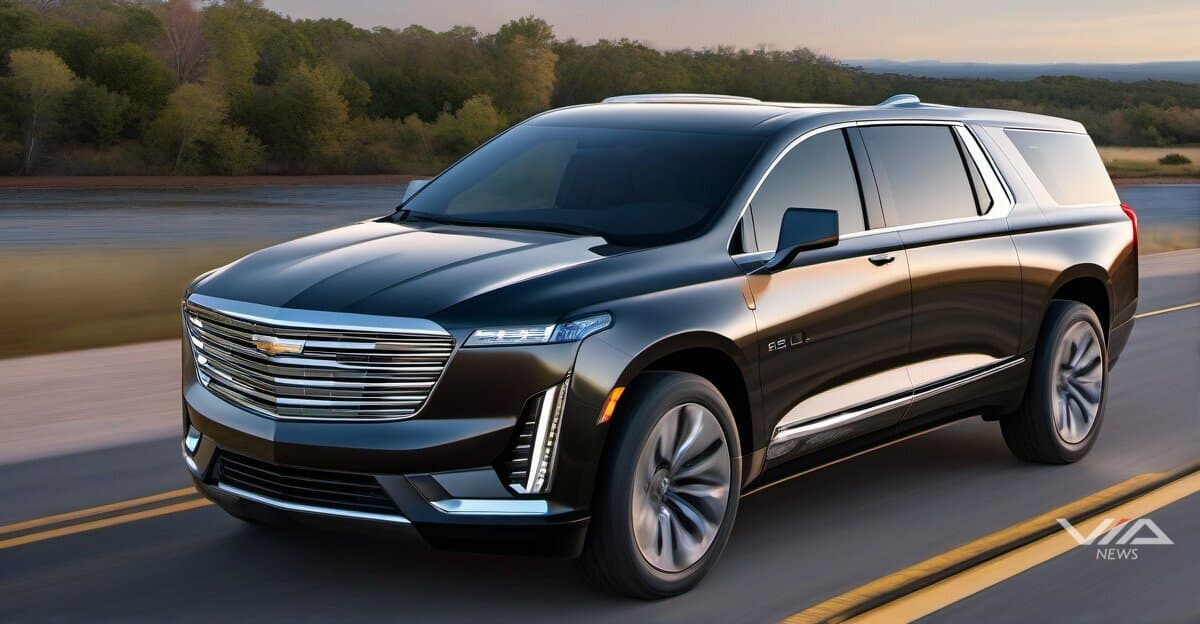
When General Motors CEO Mary Barra outlined the company's autonomous driving roadmap during the Q4 2025 earnings call on January 27, 2026, the technical details embedded in the announcement were as significant as the business milestone itself. GM is targeting a 2028 launch of SAE Level 3 autonomous driving capability on the Cadillac Escalade I — a system designed to let drivers legally divert their attention from the road entirely during highway operation.
That distinction matters enormously from an AI engineering perspective. L2 systems, like Tesla's Autopilot or GM's own Super Cruise, still legally require the driver to remain attentive and ready to intervene. L3 shifts liability to the vehicle's decision stack. The onboard AI must be trusted absolutely — not just statistically — to navigate real-world highway conditions without human oversight.
The Sensor Fusion Architecture
GM's disclosed hardware configuration centers on a triply redundant sensing layer: LIDAR, radar, and camera arrays working in concert. This is not incidental over-engineering. Each modality compensates for the failure modes of the others in ways that are fundamental to safe autonomous operation.
LIDAR provides precise three-dimensional point clouds of the vehicle's surroundings, excel at generating accurate depth maps even in low-light conditions. Radar, by contrast, penetrates rain, fog, and snow where LIDAR can degrade, and excels at measuring relative velocity of surrounding objects — critical for highway merge decisions. Cameras deliver the rich semantic context — lane markings, signage, vehicle classification — that sparse point clouds cannot easily encode.
The fusion of these streams in real time is itself a non-trivial ML problem. Modern autonomous stacks typically employ deep neural networks trained to reconcile conflicting signals across sensor modalities, assigning probabilistic confidence scores to object detections before feeding a unified world model to the planning layer. A pedestrian detected by camera but absent from LIDAR returns during heavy rain demands a system that knows to weight radar and downgrade the LIDAR null-return rather than assume the pedestrian vanished.
Decision-Making Under Uncertainty
Beyond perception, the L3 classification demands a planning and decision-making subsystem capable of handling the full complexity of highway driving: lane changes, on-ramps, speed differentials, construction zones, and emergency vehicle responses. These scenarios require the AI to reason over multi-second horizons, modeling the probable future states of dozens of surrounding agents simultaneously.
Contemporary autonomous systems increasingly lean on transformer-based architectures and reinforcement learning from human driving data to develop robust highway policies. The shift from rule-based planners to learned policies has been one of the defining technical transitions of the past half-decade in the field — and GM's 2028 target places it squarely in the era where such learned systems are mature enough for legal, commercial deployment.
Safety Redundancy as a Systems Problem
The redundancy GM has designed into the sensor stack extends, by necessity, to compute. Production L3 systems require dual or triple compute paths — if the primary inference chip fails, a secondary processor must be capable of executing a safe stop sequence independently. This hardware redundancy mirrors the sensor redundancy, and together they form the basis for the functional safety certifications (ISO 26262 ASIL-D) that regulators require before any eyes-off system reaches public roads.
GM's financial commitment underpins the engineering ambition. The company reported $12.7 billion in adjusted EBIT for 2025 and is projecting $13–15 billion in 2026, providing the capital base to sustain the multi-year R&D pipeline autonomous driving demands. With $10–12 billion in annual CapEx planned for 2026–2027, the infrastructure investment required to bring production L3 systems to market is clearly within reach.
The 2028 Cadillac Escalade I launch, if delivered on schedule, will mark one of the most consequential real-world deployments of AI/ML systems in consumer technology — a moment where the abstract promise of autonomous intelligence meets the legal and physical stakes of the open road.