
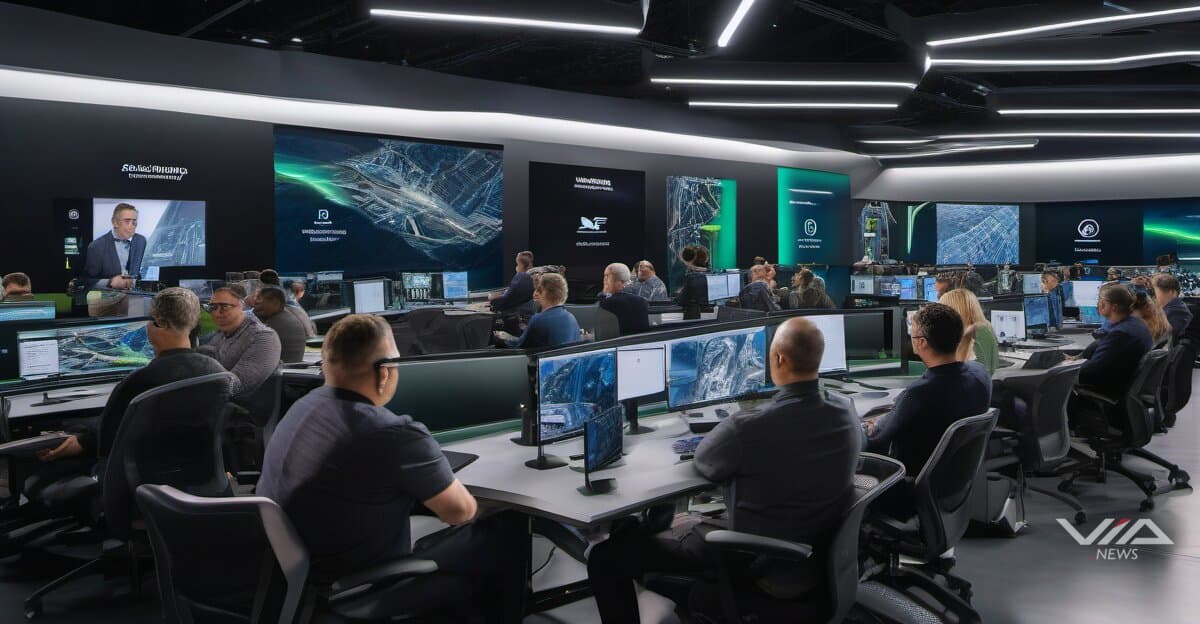
NVIDIA announced its Agent Toolkit and OpenShell platform at GTC 2026, securing integrations with Adobe, Salesforce, HPE, Atlassian, CrowdStrike, and Siemens.1 The partnerships target autonomous AI agents for creative workflows, security operations, electronic design automation, and business intelligence.
The Agent Toolkit provides infrastructure for enterprises to deploy AI agents that handle multi-step tasks without human intervention. OpenShell serves as the development platform enabling vendors to build agentic applications on NVIDIA's compute stack.
Adobe is integrating the toolkit into creative applications, allowing designers to automate complex editing sequences. Salesforce plans AI agents for customer relationship workflows. HPE and Siemens focus on industrial automation and EDA design tools that can independently optimize chip layouts and manufacturing processes.
CrowdStrike's security agents will autonomously detect and respond to threats using NVIDIA's processing architecture. Atlassian aims to deploy agents for project management and collaboration tasks across enterprise teams.
The partnerships mark a shift from standalone AI models to integrated platforms where agents coordinate across business functions. NVIDIA positions itself as the hardware and software foundation, similar to how it dominated GPU computing for machine learning training.
Enterprise adoption depends on agent reliability and integration complexity. Current AI agents struggle with ambiguous instructions and error recovery. Vendors must prove agents can handle edge cases without creating operational risks.
The consolidation around NVIDIA's platform creates dependency risk for enterprises. Organizations building on the Agent Toolkit face vendor lock-in as agents become embedded in critical workflows. Alternative platforms from Microsoft, Google, and Amazon offer competing ecosystems.
NVIDIA's strategy leverages its hardware dominance to capture the agent software layer. Success requires agents to deliver measurable productivity gains that justify infrastructure costs and integration effort.