
Sunday, September 6, 2026

Computer Vision AI Expands Beyond Image Recognition into Safety-Critical Robotics and Medical Applications

Computer vision technologies are moving from basic image recognition into complex applications like robotic manipulation, medical imaging, and autonomous systems. Companies from Deere's precision agriculture to NASA's Mars localization show real-world deployment maturity. Ethical concerns around AI safety and model reliability create tension with rapid commercial adoption.

Computer Vision AI Expands Beyond Image Recognition into Safety-Critical Robotics and Medical Applications
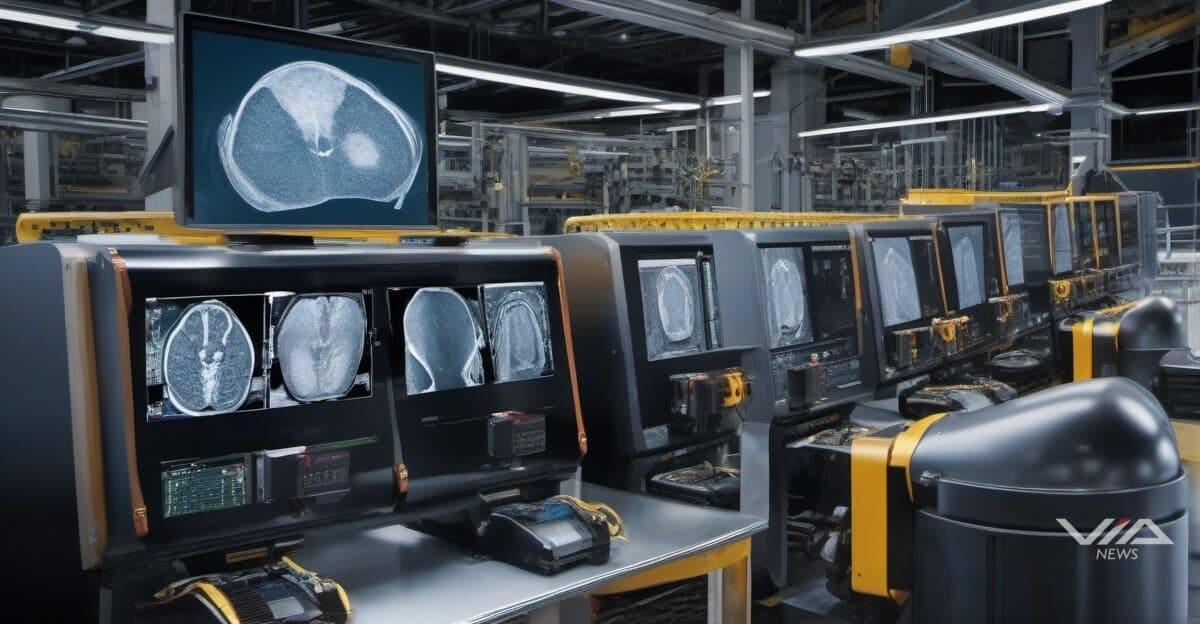
Image generated by AI for illustrative purposes. Not actual footage or photography from the reported events.
Loading stream...

Computer vision AI is shifting from industrial automation to safety-critical applications across robotics, healthcare, and autonomous systems. Multiple deployments demonstrate the technology's maturation beyond basic image recognition.

Safe Pro's threat detection systems and NASA's Mars localization technologies represent computer vision's expansion into environments where errors carry serious consequences. Deere's precision agriculture platforms apply the same visual processing capabilities to outdoor robotics under variable conditions.

Medical imaging applications face particular scrutiny. Melika Qahqaie notes that "accurate detection of merging and splitting lesions is crucial for reliable response evaluation, as overlooking these events can lead to misclassification under RECIST and potentially incorrect assessment of disease progression." The stakes in oncological imaging demand higher reliability thresholds than consumer applications.

Cultural preservation efforts at Yunju Temple show niche applications. Hui Pengyu explains that micro-trace imaging uses computer vision to enhance depth perception in stone scripture carvings, collecting "image data under light sources at different angles" to reveal millennium-old texts.

Critics question the dominant development paradigm. Timnit Gebru argues the approach involves "stealing data, killing the environment, exploiting labor." She points to market dynamics where Big Tech announcements crush specialized startups: when Meta released No Language Left Behind covering 200 languages including 55 African languages, investors told small African NLP startups to "close up shop," claiming "Facebook has solved it."

The one-size-fits-all model approach faces reliability challenges. Audio transcription AI Whisper exhibits hallucination issues despite commercial deployment, raising questions about deploying similar architectures in visual systems for medical diagnosis or autonomous navigation.

The computer vision sector now spans applications from agricultural automation requiring weather resistance to medical imaging demanding near-perfect accuracy to robotic manipulation needing real-time spatial processing. Each domain presents distinct reliability requirements and failure consequences.

Resource efficiency concerns compete with performance demands. Training large vision models requires substantial computational resources, while deployment environments from farm equipment to medical facilities may lack high-end hardware. This tension shapes architectural decisions and market access.

The gap between commercial deployment speed and responsible development practices continues widening as companies rush vision AI into safety-critical roles.

Source documents

Via News is a conduit. We point to the source documents behind this report — we don't replace them. Trace any claim to its source and decide what to trust. How we source

Source Trace Score12 source documents12 with a live linkVerifiability: High
  1. [1]News articleYahoo Finance· January 6, 2026
    Durin Debuts MagicKey(™): The First Multi-Factor Authentication for Home Entry
  2. [2]News articleAI Now Institute
    Frugal AI
  3. [3]Press releaseGlobeNewswire· December 22, 2025
    Global Times: How does Yunju Temple keep millennium-old stone scriptures alive today?
  4. [4]Peer-reviewed paperarXiv
    Unbalanced optimal transport for robust longitudinal lesion evolution with registration-aware and appearance-guided priors
  5. [5]Press releaseGlobeNewswire· February 24, 2026
    AI-Enabled Edge and Autonomous Systems Take Center Stage
  6. [6]Press releaseGlobeNewswire· February 23, 2026
    Deep Learning Market Size to Surpass $296B by 2031 as Autonomous Systems and Robotics are Set to Grow at 37.2% CAGR, Says a 2026 Mordor Intelligence Report
  7. [7]News articleYahoo Finance· January 29, 2026
    How automotive AI is moving from promise to practice
  8. [8]News articleMIT Technology Review
    The Download: Microsoft’s online reality check, and the worrying rise in measles cases
  9. [9]News articleIEEE Spectrum
    Video Friday: Autonomous Robots Learn By Doing in This Factory
  10. [10]News articleIEEE Spectrum
    Video Friday: Humanoid Robots Celebrate Spring
  11. [11]News articleIEEE Spectrum
    Video Friday: Robot Collective Stays Alive Even When Parts Die
  12. [12]Press releaseGlobeNewswire· February 17, 2026
    ZenaTech avanza su plataforma autónoma de drones con IA para lavado a presión y fortalece su presencia de Drone como Servicio en Dubái
What we know · the intelligence behind this page
Live from the substrate
What we're seeing
AI Capital Surge Meets Investor Caution: Record Funding Rounds and Government Contracts Amid Valuation Skepticism
A single-week cluster of large AI/fintech funding rounds (Socure, Stability AI, Emerald AI, Generalist AI, Instinct, Gatik, Regent Craft) shows venture capital still pouring into AI infrastructure, identity, and autonomy plays, while Palantir's Army TITAN contract win coincided with a 6% stock drop — signaling that even flagship AI-defense revenue isn't immune to market reassessment of AI valuations. Efficiency-focused innovations like Multiverse Computing's model compression suggest the sector is also pivoting toward cost/inference economics as capital intensity draws scrutiny.
Our read on the data ›
Signals we're tracking
EPKINLY Regulatory-Clinical Success Cascade
High probability of expanded label indications, additional combination approvals, and competitive positioning strength in follicular lymphoma market. Predicts positive commercial uptake and potential accelerated review for related indications.
Patterns we're watching ›
Where sources disagree
Morgan Stanley & Co. LLC
The same metric (eps) for the same entity (Morgan Stanley & Co. LLC) reported for the identical fiscal period (Q1 2026) and observation date (2026-03-31) has two conflicting values: 3.43 USD_per_share vs 3.08 USD. This is not a temporal change — both observations claim to measure the same point in time. The ~10% discrepancy (0.35 USD difference) is material for a financial metric.
We flag conflicts openly ›
Recently verified
Checked against the original source
4,981
facts traced to their source — and we flag the ones that don't hold up.
101 entities tracked4,981 facts checked against source5,273 source documents archived
Query this data → isubstrate.com