
Saturday, September 5, 2026

Micron, Dell, Intel Surge as Nasdaq Falls: AI Hardware Rotation Accelerates

Semiconductor and HPC infrastructure stocks posted sharp gains on June 25 while the Nasdaq Composite declined, confirming capital rotation from AI software into picks-and-shovels hardware plays. Micron and Dell each rose 5%, Intel gained 3.8%, and SanDisk added 4%, even as enterprise software and AI services names fell. The divergence signals a structural shift in how investors are positioning for AI growth.

LM Salvado

June 25, 2026

Micron, Dell, Intel Surge as Nasdaq Falls: AI Hardware Rotation Accelerates
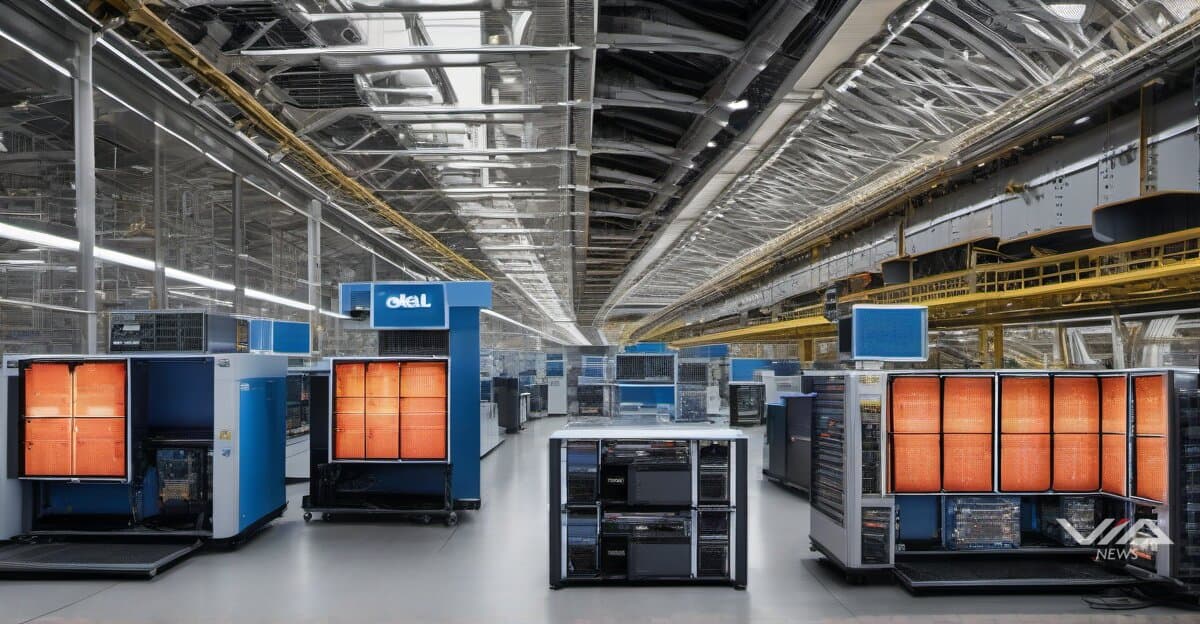
Image generated by AI for illustrative purposes. Not actual footage or photography from the reported events.
Loading stream...

Semiconductor stocks surged on June 25 while the Nasdaq Composite fell, ruling out broad risk-on sentiment and confirming a sector rotation into AI hardware infrastructure.1

Micron gained 5%. Dell rose 5%.SanDisk moved up 4%.1 Enterprise software vendors and AI services companies fell on the same day.

The divergence is the signal. When semis rally and the index drops, capital is moving between sectors — not flowing into tech as a whole. Investors are selling application-layer exposure and buying the hardware that every AI workload requires.

The investment logic is direct. Every model training run needs semiconductors, storage, and high-performance compute. These inputs are non-negotiable regardless of which AI applications ultimately win market share. Storage providers like Micron and SanDisk sit upstream of every training job. Systems vendors like Dell build the racks and clusters. Equipment suppliers like KLA enable chip fabrication at scale.

Application-layer companies face a different constraint. Enterprise software deals require procurement cycles, budget approvals, and demonstrable ROI. In a cautious spending environment, those deals slow. Hardware purchases, tied to capital expenditure plans and multi-year infrastructure commitments, are stickier.

The rotation is projected to continue over a 3-to-6 month window.1 Hardware-adjacent instruments — semiconductor ETFs, AI data center REITs — are positioned to benefit if the trend holds. Fintech AI vendors reliant on enterprise spending cycles face further pressure.

Picks-and-shovels investing predates the AI era. The merchants supplying California's gold miners often outlasted the miners. The principle applies here: whoever supplies the AI pipeline wins independent of which applications dominate. Semiconductor fabs, HPC clusters, and storage arrays are the mine shafts of this cycle.

The Nasdaq's decline during the semi rally is the clearest evidence this is a reallocation, not a tech bull run. Investors are not adding risk. They are moving it — from software promises to hardware certainty.

In this story

About this analysis

This is a Via News analysis. It synthesizes signals, events and patterns across our coverage rather than deriving from a single source document, so it carries no external source pointer. Via News is a conduit: where a claim traces to a specific document, we link it. How we source

LM Salvado

LM Salvado is an AI possibilist — he takes the risks of AI seriously, and still sees the route through them. Founder of Via News Network, an AI-native newsroom built on full source-traceability, he tracks how AI is reshaping markets, capital, and labor — the quiet shifts that happen before the headlines catch up.

What we know · the intelligence behind this page
Live from the substrate
What we're seeing
AI Capital Surge Meets Investor Caution: Record Funding Rounds and Government Contracts Amid Valuation Skepticism
A single-week cluster of large AI/fintech funding rounds (Socure, Stability AI, Emerald AI, Generalist AI, Instinct, Gatik, Regent Craft) shows venture capital still pouring into AI infrastructure, identity, and autonomy plays, while Palantir's Army TITAN contract win coincided with a 6% stock drop — signaling that even flagship AI-defense revenue isn't immune to market reassessment of AI valuations. Efficiency-focused innovations like Multiverse Computing's model compression suggest the sector is also pivoting toward cost/inference economics as capital intensity draws scrutiny.
Our read on the data ›
Signals we're tracking
EPKINLY Regulatory-Clinical Success Cascade
High probability of expanded label indications, additional combination approvals, and competitive positioning strength in follicular lymphoma market. Predicts positive commercial uptake and potential accelerated review for related indications.
Patterns we're watching ›
Where sources disagree
Morgan Stanley & Co. LLC
The same metric (eps) for the same entity (Morgan Stanley & Co. LLC) reported for the identical fiscal period (Q1 2026) and observation date (2026-03-31) has two conflicting values: 3.43 USD_per_share vs 3.08 USD. This is not a temporal change — both observations claim to measure the same point in time. The ~10% discrepancy (0.35 USD difference) is material for a financial metric.
We flag conflicts openly ›
Recently verified
Checked against the original source
4,981
facts traced to their source — and we flag the ones that don't hold up.
101 entities tracked4,981 facts checked against source5,273 source documents archived
Query this data → isubstrate.com