
Saturday, September 5, 2026

NVIDIA BioNeMo Platform Powers AI Drug Discovery Push Across Major Pharma and Biotech

NVIDIA's BioNeMo platform is being adopted by pharmaceutical leaders including Eli Lilly and Thermo Fisher to accelerate AI-driven drug discovery workflows. Multiple biotech AI companies are simultaneously launching foundation model platforms built on NVIDIA's GPU infrastructure, marking an industry-wide shift toward AI-native research methods.

LM Salvado

April 11, 2026

NVIDIA BioNeMo Platform Powers AI Drug Discovery Push Across Major Pharma and Biotech
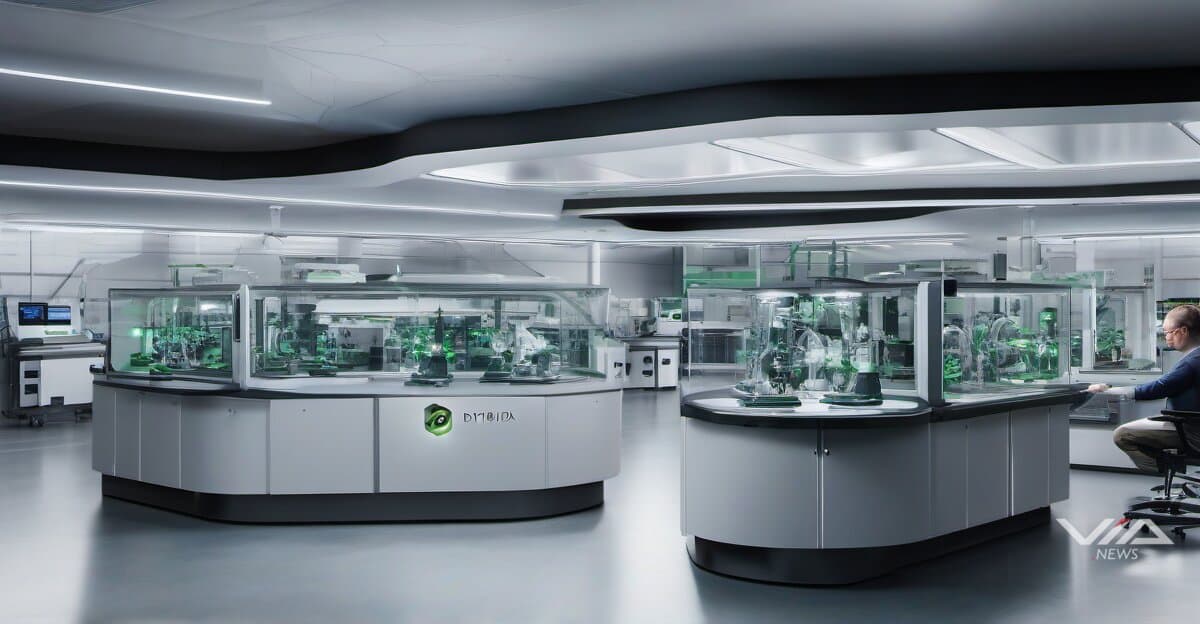
Image generated by AI for illustrative purposes. Not actual footage or photography from the reported events.
Loading stream...

NVIDIA's BioNeMo platform has been adopted by major life sciences companies including Eli Lilly and Thermo Fisher Scientific to accelerate AI-driven drug discovery workflows.1 The platform provides pre-trained AI models and GPU-optimized infrastructure specifically designed for biological research applications.

The adoption extends beyond traditional pharma. Biotech AI firms including Natera, Basecamp Research, Owkin, Edison Scientific, and Boltz Lab are building foundation model platforms on NVIDIA's technology stack.1 This concentration of development activity signals a fundamental shift in how drug discovery research is conducted, moving from traditional computational methods to AI-native workflows.

NVIDIA's strategic positioning centers on providing the computational infrastructure layer rather than competing directly in drug development. The BioNeMo platform offers pre-trained models for protein structure prediction, molecular generation, and genomic analysis—core tasks in modern pharmaceutical research. By standardizing on NVIDIA's infrastructure, biotech companies can avoid building GPU clusters and training foundation models from scratch.

The pharmaceutical industry faces mounting pressure to reduce the decade-plus timelines and billion-dollar costs typical of traditional drug development. AI-driven approaches promise to compress discovery phases by identifying promising molecular candidates faster and predicting their properties before expensive laboratory testing. Early applications focus on protein folding prediction, molecular binding analysis, and patient data analysis for precision medicine.

NVIDIA's expansion into biotech infrastructure mirrors its earlier success in autonomous vehicles and large language models, where it established GPU computing as the de facto standard. The company is replicating this pattern by partnering with industry leaders early in the adoption cycle and providing domain-specific tools that lower barriers to entry for smaller players.

The simultaneous platform launches across multiple biotech AI companies indicate the market is moving past proof-of-concept experiments toward production deployment. As more firms commit to AI-native research workflows, NVIDIA's position as the infrastructure provider strengthens, potentially creating network effects similar to those seen in other AI sectors.

Source documents

Via News is a conduit. We point to the source documents behind this report — we don't replace them. Trace any claim to its source and decide what to trust. How we source

Source Trace Score1 source document1 with a live linkVerifiability: Basic
  1. [1]News articleYahoo Finance· January 12, 2026
    NVIDIA BioNeMo Platform Adopted by Life Sciences Leaders to Accelerate AI-Driven Drug Discovery

In this story

LM Salvado

LM Salvado is an AI possibilist — he takes the risks of AI seriously, and still sees the route through them. Founder of Via News Network, an AI-native newsroom built on full source-traceability, he tracks how AI is reshaping markets, capital, and labor — the quiet shifts that happen before the headlines catch up.

What we know · the intelligence behind this page
Live from the substrate
What we're seeing
AI Capital Surge Meets Investor Caution: Record Funding Rounds and Government Contracts Amid Valuation Skepticism
A single-week cluster of large AI/fintech funding rounds (Socure, Stability AI, Emerald AI, Generalist AI, Instinct, Gatik, Regent Craft) shows venture capital still pouring into AI infrastructure, identity, and autonomy plays, while Palantir's Army TITAN contract win coincided with a 6% stock drop — signaling that even flagship AI-defense revenue isn't immune to market reassessment of AI valuations. Efficiency-focused innovations like Multiverse Computing's model compression suggest the sector is also pivoting toward cost/inference economics as capital intensity draws scrutiny.
Our read on the data ›
Signals we're tracking
EPKINLY Regulatory-Clinical Success Cascade
High probability of expanded label indications, additional combination approvals, and competitive positioning strength in follicular lymphoma market. Predicts positive commercial uptake and potential accelerated review for related indications.
Patterns we're watching ›
Where sources disagree
Morgan Stanley & Co. LLC
The same metric (eps) for the same entity (Morgan Stanley & Co. LLC) reported for the identical fiscal period (Q1 2026) and observation date (2026-03-31) has two conflicting values: 3.43 USD_per_share vs 3.08 USD. This is not a temporal change — both observations claim to measure the same point in time. The ~10% discrepancy (0.35 USD difference) is material for a financial metric.
We flag conflicts openly ›
Recently verified
Checked against the original source
4,981
facts traced to their source — and we flag the ones that don't hold up.
101 entities tracked4,981 facts checked against source5,273 source documents archived
Query this data → isubstrate.com