
Saturday, September 5, 2026

NVIDIA's BioNeMo Emerges as Core Infrastructure Layer as Pharma Rebuilds R&D Around AI Platforms

NVIDIA's BioNeMo platform is becoming the foundational compute layer for AI-driven pharmaceutical discovery, with Novo Nordisk and Eli Lilly restructuring R&D around AI-native workflows. Novo Nordisk posted strong Q1 2026 earnings and a 25% stock surge after closing its internal cell therapy unit and outsourcing Parkinson's development to AI-platform company Cellular Intelligence. A concurrent wave of platform launches — Basecamp Research EDEN, Boltz Lab, Owkin OwkinZero, Edison Scientific Kosmo

LM Salvado

May 18, 2026

NVIDIA's BioNeMo Emerges as Core Infrastructure Layer as Pharma Rebuilds R&D Around AI Platforms
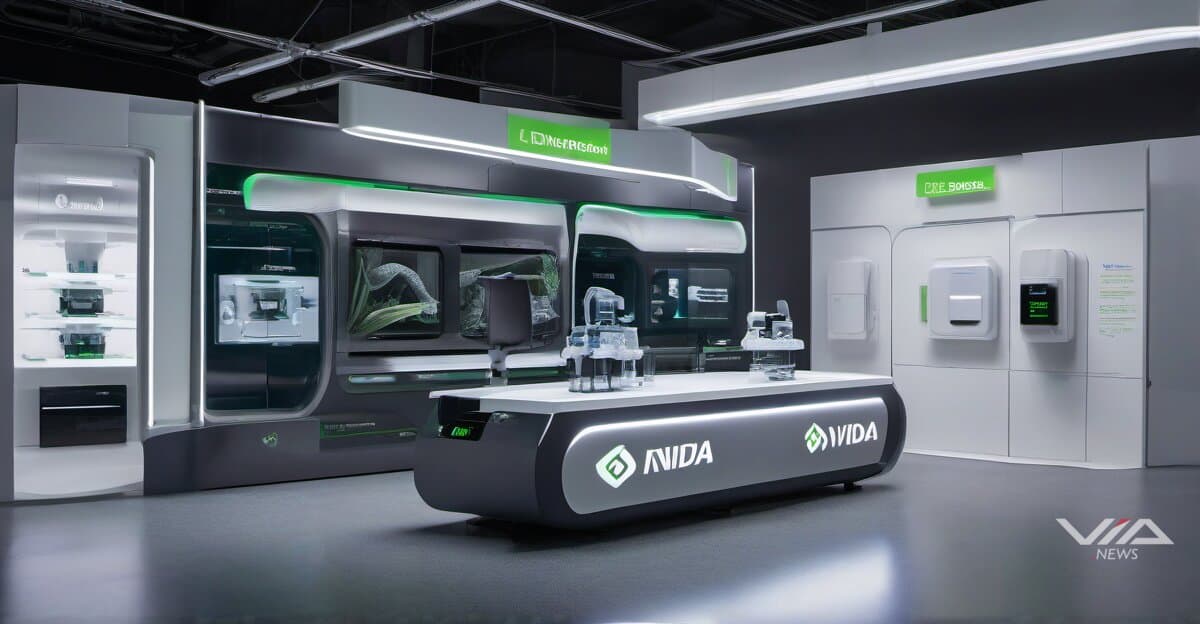
Image generated by AI for illustrative purposes. Not actual footage or photography from the reported events.
Loading stream...

NVIDIA's BioNeMo platform is becoming the backbone of AI-driven drug discovery, with major pharmaceutical companies now restructuring R&D workflows around it.1 The shift moves the industry from isolated AI experiments to platform-dependent production pipelines.

Novo Nordisk's stock rose 25% over 30 days following strong Q1 2026 earnings, driven partly by its leaner, licensing-first strategy.1 The company closed its internal cell therapy unit and outsourced Parkinson's disease development to Cellular Intelligence, an AI-platform company.1 The move reflects a broader bet: pharmaceutical R&D efficiency now runs through external AI infrastructure, not internal labs.

Eli Lilly is also realigning R&D around AI-native workflows, joining Novo Nordisk in treating foundation models as operational infrastructure rather than research tools.1

Five platform launches have occurred in rapid succession: Basecamp Research's EDEN, Boltz Lab, Owkin's OwkinZero, Edison Scientific's Kosmos, and Natera's new offering.1 The clustering signals a market transition — the field is productizing, not experimenting. NVIDIA sits at the compute and tooling layer across all of them.

BioNeMo provides pre-trained biological foundation models covering proteins, DNA, and small molecules. Pharmaceutical teams use it to accelerate target identification and molecular generation without building models from scratch. NVIDIA's role mirrors what AWS became to software: invisible infrastructure that every serious player depends on.

The Cellular Intelligence deal with Novo Nordisk illustrates the new deal structure emerging in biotech. Instead of acquiring AI companies or building internal teams, large pharma licenses AI platform access and development rights. Capital stays flexible. R&D risk shifts to platform providers.

The wave of new platforms also introduces competitive pressure below NVIDIA. Owkin's OwkinZero targets federated learning across hospital data. Basecamp Research's EDEN focuses on biodiversity-derived molecular datasets. Each carves a vertical niche while relying on NVIDIA compute underneath.

The overall signal is consolidation around infrastructure. Foundation models are no longer a differentiator — they are table stakes. Competitive advantage now sits in proprietary datasets, domain-specific fine-tuning, and clinical partnerships built on top of shared compute layers.

Source documents

Via News is a conduit. We point to the source documents behind this report — we don't replace them. Trace any claim to its source and decide what to trust. How we source

Source Trace Score2 source documents2 with a live linkVerifiability: Strong
  1. [1]News articleYahoo Finance· May 11, 2026
    Novo Nordisk Refocuses On GLP‑1 As AI Partner Advances Parkinson’s Bet
  2. [2]News articleYahoo Finance· January 12, 2026
    NVIDIA BioNeMo Platform Adopted by Life Sciences Leaders to Accelerate AI-Driven Drug Discovery

In this story

LM Salvado

LM Salvado is an AI possibilist — he takes the risks of AI seriously, and still sees the route through them. Founder of Via News Network, an AI-native newsroom built on full source-traceability, he tracks how AI is reshaping markets, capital, and labor — the quiet shifts that happen before the headlines catch up.

What we know · the intelligence behind this page
Live from the substrate
What we're seeing
AI Capital Surge Meets Investor Caution: Record Funding Rounds and Government Contracts Amid Valuation Skepticism
A single-week cluster of large AI/fintech funding rounds (Socure, Stability AI, Emerald AI, Generalist AI, Instinct, Gatik, Regent Craft) shows venture capital still pouring into AI infrastructure, identity, and autonomy plays, while Palantir's Army TITAN contract win coincided with a 6% stock drop — signaling that even flagship AI-defense revenue isn't immune to market reassessment of AI valuations. Efficiency-focused innovations like Multiverse Computing's model compression suggest the sector is also pivoting toward cost/inference economics as capital intensity draws scrutiny.
Our read on the data ›
Signals we're tracking
EPKINLY Regulatory-Clinical Success Cascade
High probability of expanded label indications, additional combination approvals, and competitive positioning strength in follicular lymphoma market. Predicts positive commercial uptake and potential accelerated review for related indications.
Patterns we're watching ›
Where sources disagree
Morgan Stanley & Co. LLC
The same metric (eps) for the same entity (Morgan Stanley & Co. LLC) reported for the identical fiscal period (Q1 2026) and observation date (2026-03-31) has two conflicting values: 3.43 USD_per_share vs 3.08 USD. This is not a temporal change — both observations claim to measure the same point in time. The ~10% discrepancy (0.35 USD difference) is material for a financial metric.
We flag conflicts openly ›
Recently verified
Checked against the original source
4,981
facts traced to their source — and we flag the ones that don't hold up.
101 entities tracked4,981 facts checked against source5,273 source documents archived
Query this data → isubstrate.com