
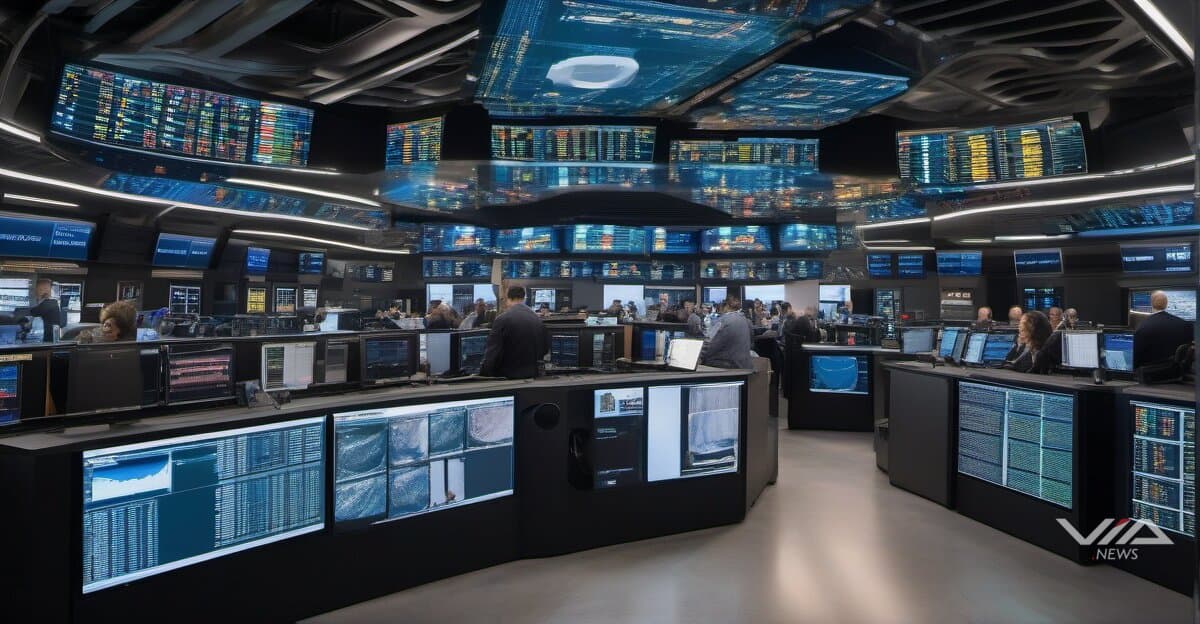
Institutional market makers are scaling deep learning trading infrastructure as a wave of retail-focused AI platforms enters the market with aggressive performance claims.
Flow Traders, a major market maker, is deploying advanced deep learning systems to maintain competitive positioning. The firm's investment reflects an industry-wide technology arms race among established quantitative trading operations.
Vorexlan launched in 2025-2026 as a cloud-based multi-asset trading platform. The system uses multi-layer neural networks to process market data, anomaly detection models for irregular price behavior, and adaptive algorithms that refine strategies based on continuous data streams. The platform analyzes thousands of data points simultaneously across cryptocurrencies, forex, commodities, indices, and equities.
Vorexlan operates as a services company earning revenue through partnered broker relationships. The firm requires a $250 minimum deposit and partners with regulated brokers for execution and liquidity routing. The platform is operational in Europe, Asia, Latin America, Oceania, and select African markets.
Similar platforms including Quantum AI and nof1.ai's Alpha Arena have launched with comparable AI automation promises. The proliferation echoes Renaissance Technologies' legendary track record of 66% annual returns generated through mathematical trading models.
The divergence between institutional and retail AI trading represents a critical market bifurcation. Established quantitative firms like Flow Traders have decades of infrastructure, talent, and capital to develop proven deep learning systems. Retail platforms face challenges replicating institutional-grade capabilities while managing regulatory compliance across multiple jurisdictions.
Vorexlan implements SSL encryption, two-factor authentication, and tokenized session systems for security. The platform adheres to KYC and AML requirements, requiring government-issued ID and proof of residence for account activation.
The retail platform business model differs fundamentally from institutional operations. Vorexlan does not gain or lose profits based on user trading activity, instead earning through broker partnerships. This structure separates platform revenue from user performance outcomes.
Market observers note that Renaissance Technologies' success required decades of mathematical and computational expertise. Whether retail AI platforms can deliver comparable results through automated systems remains an open question as the technology arms race accelerates.