
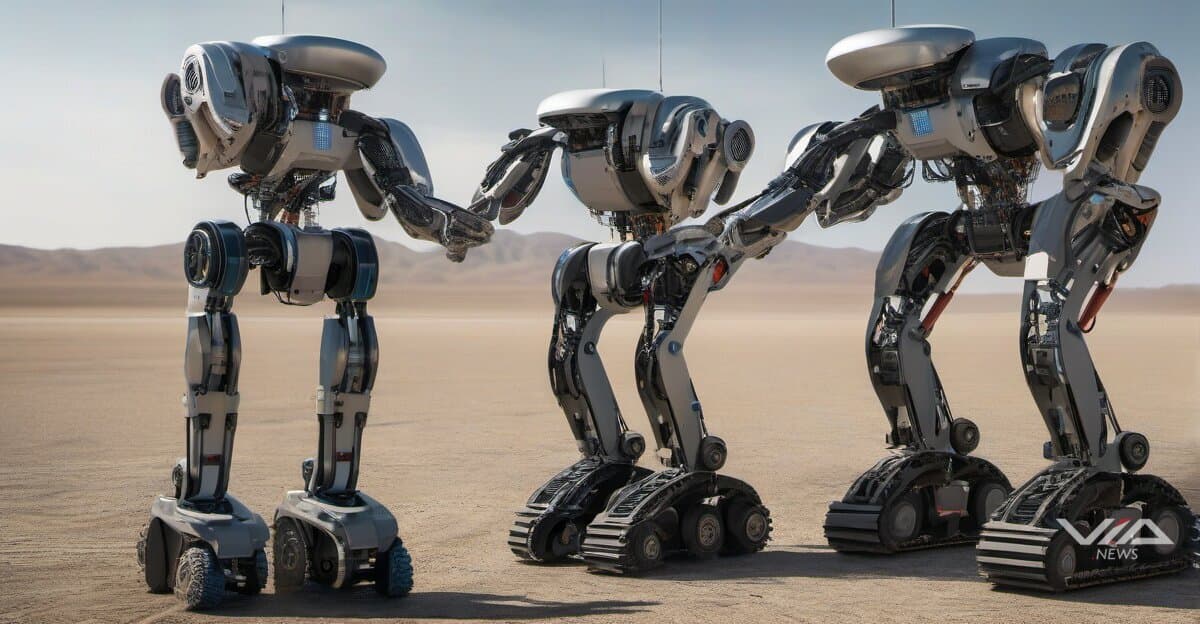
The robotics industry is undergoing a transformation that analysts are beginning to describe not as incremental progress, but as a structural shift in how physical work gets done. Across autonomous vehicles, humanoid robots, and industrial AI platforms, the window between experimental pilot and mass commercial deployment is narrowing fast — and the major players are racing to claim territory before the market solidifies.
Nowhere is this clearer than in the autonomous vehicle sector. WeRide (NASDAQ: WRD), one of the most geographically diversified AV operators in the world, reported robotaxi revenue growth of 761% year-over-year in Q3 2025, reaching RMB 35.3 million (approximately $5 million USD). Total revenue hit $24 million for the quarter — a 144.3% annual increase — while gross margins expanded dramatically from 6.5% to 32.9%, signaling that the unit economics are finally beginning to work. The company now operates across 30+ cities in 11 countries and is licensed in eight, with a public passenger robotaxi service in Singapore targeted for launch in early 2026.
WeRide's UAE milestone — securing a landmark driverless robotaxi commercial permit — underscores a broader regulatory opening that is enabling deployment at scale across multiple jurisdictions simultaneously. This kind of multi-market regulatory infrastructure, once a years-long bottleneck, is now forming in parallel with the technology's maturation.
On the humanoid front, Mobileye's acquisition of Mentee Robotics marks a significant consolidation move. Prof. Lior Wolf, a key figure behind Mentee's technology, stated the deal gives the company "access to unparalleled AI infrastructure and commercialization expertise," framing the union explicitly around scalable, cost-effective market entry rather than further R&D. Mobileye's existing automotive AI stack — honed over years of ADAS deployment — gives humanoid development a rare shortcut: battle-tested perception and decision-making systems that can be adapted rather than rebuilt from scratch.
Hardware economics are also shifting in favor of mass deployment. Hesai Technology, a leading LiDAR manufacturer, is targeting sub-$200 price points for its next-generation ATX LiDAR sensors. The automotive LiDAR market, projected to reach $25.75 billion by 2035 according to Astute Analytica, depends heavily on this kind of commoditization. When a sensor that once cost thousands of dollars drops below $200, it stops being a cost barrier and starts being a line item — and that changes everything about the business case for autonomous systems at scale.
Industrial robotics is following a parallel trajectory. Path Robotics and Amazon Robotics are among the players pushing automated systems deeper into manufacturing and logistics workflows, with 2026-2028 widely cited as the window for broad commercial rollout across warehouse automation, autonomous shipbuilding, and public transit applications.
What distinguishes this moment from prior robotics hype cycles is the convergence of multiple enabling factors arriving simultaneously: sensor costs declining, regulatory pathways opening, AI inference becoming cheaper, and capital — including WeRide's $764 million in total liquid assets — providing the runway to sustain deployment-phase losses while revenue scales.
The question is no longer whether physical AI will reach mass deployment. It is which companies will have locked in the infrastructure, partnerships, and regulatory relationships by the time the market tips — and that race is already well underway.