
Saturday, September 5, 2026

Physical AI Robotics Reach 98% Warehouse Accuracy as Autonomous Vehicles Target 2026 Production

AI-powered warehouse automation systems now achieve 98%+ accuracy rates as the robotics industry shifts from R&D to commercial deployment. Autonomous vehicle manufacturers have set 2026-2027 production timelines while defense and industrial partnerships accelerate physical AI integration across multiple sectors.

Physical AI Robotics Reach 98% Warehouse Accuracy as Autonomous Vehicles Target 2026 Production
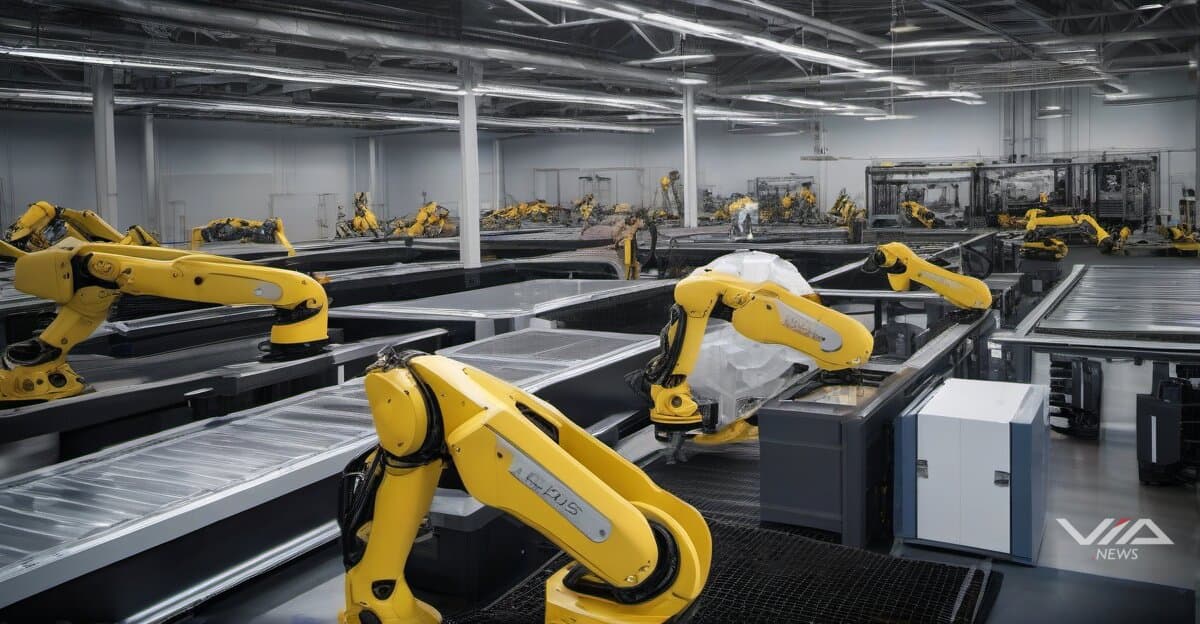
Image generated by AI for illustrative purposes. Not actual footage or photography from the reported events.
Loading stream...

AI-powered warehouse robotics systems have crossed the 98% accuracy threshold as the industry enters commercial deployment phase across autonomous vehicles, manufacturing, and logistics sectors.

Autonomous vehicle manufacturers have confirmed 2026-2027 production timelines, marking the transition from pilot programs to mass manufacturing. The convergence of AI breakthroughs with AI-RAN 5G telecom infrastructure enables real-time processing for navigation and object recognition systems.

Warehouse automation represents the most mature deployment category. Systems using computer vision and machine learning now handle inventory management, order fulfillment, and quality control with minimal human intervention. The 98%+ accuracy rates match or exceed human performance in repetitive tasks while operating 24/7.

Defense contractors and industrial manufacturers have formed partnerships to deploy physical AI in production facilities. These systems integrate sensors, actuators, and decision-making algorithms to perform complex assembly tasks previously requiring human dexterity and judgment.

Regulatory approvals are expanding access to assistive robotics in healthcare and service industries. Agencies have cleared devices for patient mobility assistance, surgical support, and rehabilitation therapy after validation studies demonstrated safety profiles comparable to existing medical equipment.

The commercial acceleration follows years of laboratory development. Companies can now source standardized components—vision systems, manipulator arms, mobility platforms—and integrate them with custom AI models trained on industry-specific datasets. This modular approach reduces deployment costs and development timelines.

Manufacturing automation benefits from robots that adapt to production line changes without extensive reprogramming. Machine learning models learn new assembly patterns from human demonstrations, then optimize the process through repetition. Factories report 30-40% efficiency gains after full integration.

Five sectors dominate current deployments: logistics fulfillment centers, automotive manufacturing, warehouse inventory management, food processing facilities, and electronics assembly plants. Each has moved beyond proof-of-concept to multi-site implementations with documented ROI.

The shift from research to commercialization indicates the technology has matured beyond academic curiosity into reliable business infrastructure capable of replacing or augmenting human labor at scale.

Source documents

Via News is a conduit. We point to the source documents behind this report — we don't replace them. Trace any claim to its source and decide what to trust. How we source

Source Trace Score12 source documents12 with a live linkVerifiability: Strong
  1. [1]News articleCrunchbase News
    5 Interesting Startup Deals You May Have Missed: Plant-Based Clothing Dyes, A Shoebox-Picking Robot, And Power Generated On The Moon
  2. [2]News articleYahoo Finance· February 3, 2026
    Dassault Systèmes and NVIDIA Partner to Build Industrial AI Platform Powering Virtual Twins
  3. [3]News articleYahoo Finance· February 17, 2026
    Lifeward’s ReWalk™ Personal Exoskeleton Now Covered by Aetna, Coverage Expands to Include Three of the Largest Medicare Advantage Insurers
  4. [4]News articleYahoo Finance· January 5, 2026
    Lucid, Nuro, and Uber Unveil Global Robotaxi at CES, Announce Autonomous On-Road Testing
  5. [5]News articleIEEE Spectrum
    Xiangyi Cheng Is Bringing AR to Classrooms and Hospitals
  6. [6]Press releaseGlobeNewswire· February 13, 2026
    $9.8 Billion in Autonomy Spending Hits the AI-Boosted Defense Supply Chain
  7. [7]News articleYahoo Finance· December 8, 2025
    Apple won’t be the same in 2026. Meet the company’s next generation of leaders and rising stars after its biggest executive exodus in years
  8. [8]Press releaseGlobeNewswire· February 23, 2026
    Deep Learning Market Size to Surpass $296B by 2031 as Autonomous Systems and Robotics are Set to Grow at 37.2% CAGR, Says a 2026 Mordor Intelligence Report
  9. [9]News articleYahoo Finance· February 25, 2026
    Innoviz Reports Fourth Quarter and Full Year 2025 Results
  10. [10]Press releaseGlobeNewswire· March 1, 2026
    Nokia accelerates AI-RAN momentum with new partnerships driving path to AI-Native 6G #MWC26
  11. [11]News articleMIT Technology Review
    The Download: how America lost its lead in the hunt for alien life, and ambitious battery claims
  12. [12]News articleIEEE Spectrum
    Video Friday: Humanoid Robots Celebrate Spring

In this story

What we know · the intelligence behind this page
Live from the substrate
What we're seeing
AI Capital Surge Meets Investor Caution: Record Funding Rounds and Government Contracts Amid Valuation Skepticism
A single-week cluster of large AI/fintech funding rounds (Socure, Stability AI, Emerald AI, Generalist AI, Instinct, Gatik, Regent Craft) shows venture capital still pouring into AI infrastructure, identity, and autonomy plays, while Palantir's Army TITAN contract win coincided with a 6% stock drop — signaling that even flagship AI-defense revenue isn't immune to market reassessment of AI valuations. Efficiency-focused innovations like Multiverse Computing's model compression suggest the sector is also pivoting toward cost/inference economics as capital intensity draws scrutiny.
Our read on the data ›
Signals we're tracking
EPKINLY Regulatory-Clinical Success Cascade
High probability of expanded label indications, additional combination approvals, and competitive positioning strength in follicular lymphoma market. Predicts positive commercial uptake and potential accelerated review for related indications.
Patterns we're watching ›
Where sources disagree
Morgan Stanley & Co. LLC
The same metric (eps) for the same entity (Morgan Stanley & Co. LLC) reported for the identical fiscal period (Q1 2026) and observation date (2026-03-31) has two conflicting values: 3.43 USD_per_share vs 3.08 USD. This is not a temporal change — both observations claim to measure the same point in time. The ~10% discrepancy (0.35 USD difference) is material for a financial metric.
We flag conflicts openly ›
Recently verified
Checked against the original source
4,981
facts traced to their source — and we flag the ones that don't hold up.
101 entities tracked4,981 facts checked against source5,273 source documents archived
Query this data → isubstrate.com