
Saturday, September 5, 2026

Robotics Exits the Lab as Commercial Products Launch Alongside Rising AI Ethics Scrutiny

Early 2026 brings commercial robotics launches including Weave's laundry robot and Boston Dynamics' finalized Atlas platform, supported by Harvard's soft robotics manufacturing advances and EPFL's fault-tolerant robot collective research. These deployments coincide with mounting AI ethics controversies, including Google's disputed medical advice features and voice theft lawsuits, exposing gaps between technical capability and governance.

Robotics Exits the Lab as Commercial Products Launch Alongside Rising AI Ethics Scrutiny
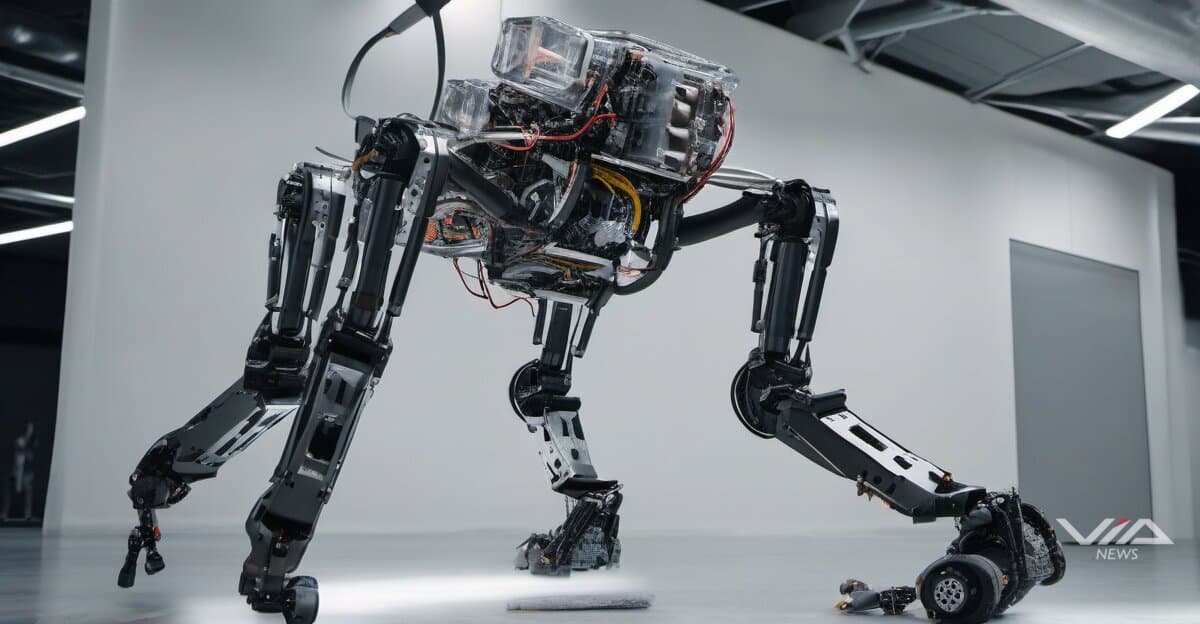
Image generated by AI for illustrative purposes. Not actual footage or photography from the reported events.
Loading stream...

Boston Dynamics finalized its Atlas humanoid platform in February 2026 while Weave launched a commercial laundry-folding robot, marking robotics' shift from research to consumer products. The deployments follow Harvard's breakthrough in soft robotics manufacturing techniques and EPFL's demonstration of fault-tolerant robot collectives that maintain function despite individual unit failures.

Harvard's manufacturing process enables mass production of soft robots that adapt to irregular surfaces and fragile objects. EPFL's research shows robot swarms maintain 85% efficiency when 30% of units fail, crucial for warehouse and logistics applications. Boston Dynamics' Atlas platform now supports third-party development, opening humanoid robotics to broader commercial use.

Weave's laundry robot represents the first viable home robotics application beyond vacuums, using computer vision to identify garment types and adjust folding patterns. The $1,800 device targets the 47% of dual-income households that cite laundry as their most time-consuming chore.

These advances emerge as AI ethics concerns intensify. Google faces criticism for burying safety warnings on AI-generated medical advice behind "Show more" buttons, displaying cautions only when users click through. The design choice draws scrutiny from medical professionals who warn against AI health recommendations without prominent disclaimers.

Voice theft lawsuits target AI companies training models on artists' vocals without consent. Plaintiffs argue unauthorized voice replication violates personality rights and creates commercial harm. The cases test intellectual property law in AI contexts, with outcomes likely shaping future training data policies.

MIT Technology Review notes antimicrobial resistance now links to over 4 million annual deaths, highlighting AI's potential medical applications amid safety debates. The publication frames hydrogen-powered trains as a "Rorschach test" for transportation's future, exemplifying polarized views on technology adoption.

The robotics deployment wave shows technical maturity reaching commercial viability. Harvard, EPFL, Boston Dynamics, and Weave collectively demonstrate manufacturing scale, fault tolerance, platform flexibility, and consumer applications. Yet simultaneous ethics controversies reveal regulatory frameworks lag behind capability advances, creating uncertainty for companies navigating deployment without clear governance standards.

Source documents

Via News is a conduit. We point to the source documents behind this report — we don't replace them. Trace any claim to its source and decide what to trust. How we source

Source Trace Score12 source documents12 with a live linkVerifiability: Strong
  1. [1]News articleMIT Technology Review
    The Download: a blockchain enigma, and the algorithms governing our lives
  2. [2]News articleMIT Technology Review
    The Download: autonomous narco submarines, and virtue signaling chatbots
  3. [3]News articleMIT Technology Review
    The Download: the rise of luxury car theft, and fighting antimicrobial resistance
  4. [4]News articleMIT Technology Review
    The Download: unraveling a death threat mystery, and AI voice recreation for musicians
  5. [5]News articleVentureBeat AI
    Claude Code costs up to $200 a month. Goose does the same thing for free.
  6. [6]News articleAI Now Institute
    Frugal AI
  7. [7]News articleIEEE Spectrum
    How Do You Define an AI Companion?
  8. [8]News articleYahoo Finance· January 28, 2026
    Meta Reports Fourth Quarter and Full Year 2025 Results
  9. [9]Press releaseGlobeNewswire· February 10, 2026
    OnSpark Launches AI-Powered Partnership Engine Built to Replace Guesswork With Verified Growth Opportunities
  10. [10]News articleVentureBeat AI
    Railway secures $100 million to challenge AWS with AI-native cloud infrastructure
  11. [11]News articleIEEE Spectrum
    Video Friday: Autonomous Robots Learn By Doing in This Factory
  12. [12]News articleIEEE Spectrum
    Video Friday: Robot Collective Stays Alive Even When Parts Die
What we know · the intelligence behind this page
Live from the substrate
What we're seeing
AI Capital Surge Meets Investor Caution: Record Funding Rounds and Government Contracts Amid Valuation Skepticism
A single-week cluster of large AI/fintech funding rounds (Socure, Stability AI, Emerald AI, Generalist AI, Instinct, Gatik, Regent Craft) shows venture capital still pouring into AI infrastructure, identity, and autonomy plays, while Palantir's Army TITAN contract win coincided with a 6% stock drop — signaling that even flagship AI-defense revenue isn't immune to market reassessment of AI valuations. Efficiency-focused innovations like Multiverse Computing's model compression suggest the sector is also pivoting toward cost/inference economics as capital intensity draws scrutiny.
Our read on the data ›
Signals we're tracking
EPKINLY Regulatory-Clinical Success Cascade
High probability of expanded label indications, additional combination approvals, and competitive positioning strength in follicular lymphoma market. Predicts positive commercial uptake and potential accelerated review for related indications.
Patterns we're watching ›
Where sources disagree
Morgan Stanley & Co. LLC
The same metric (eps) for the same entity (Morgan Stanley & Co. LLC) reported for the identical fiscal period (Q1 2026) and observation date (2026-03-31) has two conflicting values: 3.43 USD_per_share vs 3.08 USD. This is not a temporal change — both observations claim to measure the same point in time. The ~10% discrepancy (0.35 USD difference) is material for a financial metric.
We flag conflicts openly ›
Recently verified
Checked against the original source
4,981
facts traced to their source — and we flag the ones that don't hold up.
101 entities tracked4,981 facts checked against source5,273 source documents archived
Query this data → isubstrate.com