
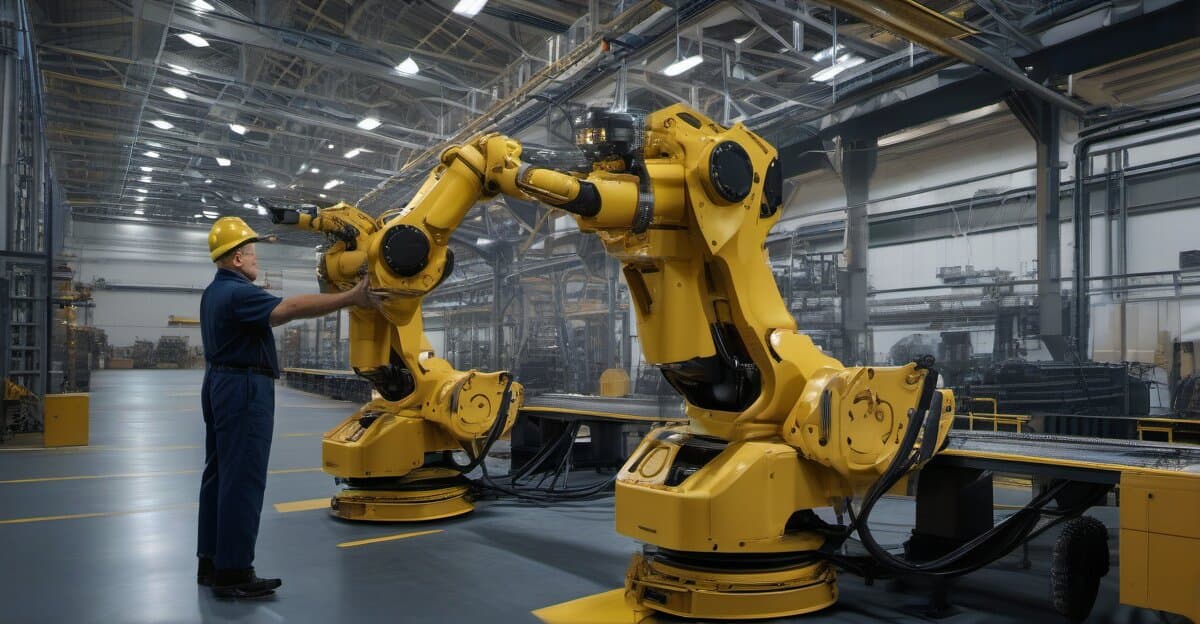
For years, the promise of physical AI — robots that can perceive, reason, and act in unstructured real-world environments — has been measured in controlled demonstrations and cautious pilot programs. That era appears to be ending. Across naval shipyards, aerospace factories, and ground support operations, autonomous systems are being embedded into the critical infrastructure of defense manufacturing at a scale that was unthinkable just a few years ago.
The most concrete signal of this shift comes from a partnership between HII, one of America's largest naval shipbuilders, and Path Robotics, an AI-driven welding company. The two organizations are deploying autonomous welding systems directly into naval vessel production lines — not as a test, but as a core component of manufacturing operations. Welding is among the most technically demanding tasks in shipbuilding, requiring precise judgment about material properties, joint geometry, and environmental conditions. The fact that an AI system can now perform this work reliably enough for defense-grade vessels is a meaningful threshold crossed.
The broader context makes the timing unsurprising. The United States Congress recently passed an $839 billion defense spending bill, injecting unprecedented capital into the defense industrial base. When procurement budgets are this large, contractors face enormous pressure to scale production capacity faster than traditional labor markets can supply. Autonomous robotics offers the most direct solution: systems that can operate continuously, maintain consistent quality tolerances, and be replicated without the years-long training pipeline that skilled welders and machinists require.
The aerospace sector is reinforcing the same narrative. Howmet Aerospace, a major supplier of structural components for aircraft and defense platforms, recently reported record performance metrics — a sign that advanced manufacturing output is under real demand pressure. Companies operating at the frontier of aerospace production are increasingly turning to automation not merely to cut costs, but to meet delivery commitments that human-staffed lines cannot fulfill at current volumes.
Beyond the factory floor, the autonomous systems transition is visible in adjacent domains. Driverless ground support vehicles are being integrated into airfield and depot operations, reducing the logistical friction of moving equipment and materials across large industrial facilities. These systems represent a different category of physical AI — less about precision manufacturing and more about reliable, scalable logistics automation in complex outdoor environments.
What distinguishes the current moment from previous automation waves is the role of machine learning in making these systems adaptive. Earlier industrial robots required exhaustive pre-programming for every task variation. Contemporary physical AI platforms learn from operational data, adjust to new material batches or design revisions, and flag anomalies that would previously have required human inspection. The Path Robotics welding system, for instance, uses computer vision and real-time feedback loops to compensate for the natural variability in metal fabrication — a capability that no purely rule-based system could replicate.
The implications extend beyond efficiency gains. As autonomous systems accumulate operational hours in high-stakes defense environments, they are generating the validated performance records that regulatory bodies and procurement officers require before broader adoption. Each successful deployment in a naval shipyard or aerospace plant lowers the credibility barrier for the next deployment — creating a compounding dynamic that analysts describe as the maturation flywheel of physical AI.
The defense industrial base has historically been a proving ground for technologies that later diffuse across the broader economy. If AI-powered welding and autonomous ground systems can meet the quality and reliability standards of naval and aerospace manufacturing, the path to commercial construction, energy infrastructure, and heavy industry becomes significantly shorter.