
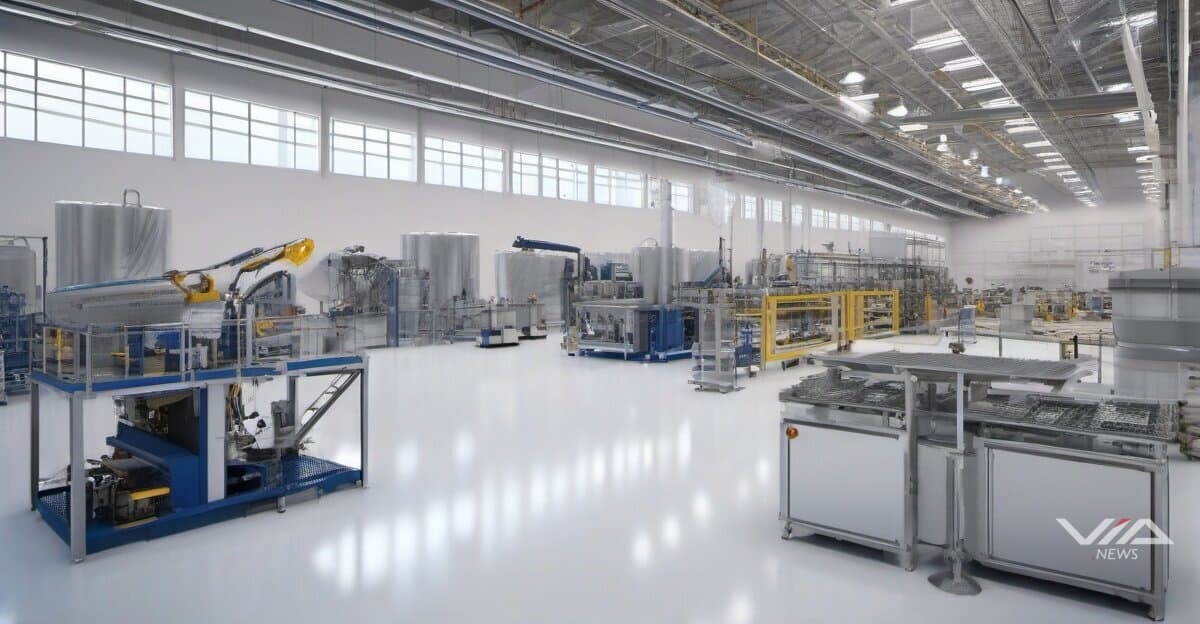
When Amkor Technology fires up production lines at its new Arizona campus, it will not just be another factory opening — it will signal a structural shift in how the United States builds and secures its artificial intelligence hardware supply chain.
Scheduled to begin production in 2028, the facility will house approximately 750,000 square feet of cleanroom space, making it one of the largest advanced semiconductor packaging sites ever constructed on American soil. The scale is deliberate: this is infrastructure designed for the demands of next-generation AI accelerators, high-bandwidth memory stacks, and the complex multi-chip modules that power everything from data center GPUs to autonomous vehicle processors.
Why Packaging Is the New Battleground
For years, the semiconductor policy conversation in Washington and in boardrooms focused almost exclusively on wafer fabrication — building fabs to produce chips domestically. But packaging, the process of assembling, interconnecting, and protecting those chips into finished components, has quietly become an equally critical chokepoint.
Advanced packaging techniques — including fan-out wafer-level packaging, 2.5D interposers, and chip-on-wafer-on-substrate (CoWoS) — are now essential to delivering the performance AI workloads demand. NVIDIA's H100 and B200 GPUs, for instance, depend heavily on advanced packaging to bond high-bandwidth memory directly alongside compute dies. Without robust domestic packaging capacity, even chips fabricated in Arizona or Ohio still face a journey to Asia before they can be deployed.
Amkor's Arizona investment directly addresses that gap.
Aligning with the CHIPS Act Vision
The facility is a direct beneficiary of the industrial policy wave set in motion by the CHIPS and Science Act, which allocated billions to rebuild America's semiconductor ecosystem. Apple — one of Amkor's largest customers — has publicly committed to sourcing advanced packaging services from the Arizona plant, providing an anchor customer relationship that de-risks the investment and signals confidence in the facility's capabilities.
The broader wafer dicing and packaging services market reflects this momentum. According to analysis from Astute Analytica, the global wafer dicing services market is projected to exceed $932.9 million by 2035, driven by surging demand for miniaturized, high-performance semiconductor components across AI, automotive, and consumer electronics sectors. Domestic capacity expansions like Amkor's are positioned to capture a meaningful share of that growth.
Implications for the AI Hardware Ecosystem
For AI hardware developers and hyperscalers, a mature US-based packaging ecosystem matters beyond geopolitics. It means shorter supply chains, faster iteration cycles, and reduced exposure to the kind of disruptions — trade restrictions, natural disasters, geopolitical tensions — that have periodically throttled chip supply in recent years.
It also matters for the next wave of AI chip architectures. As chipmakers push toward increasingly heterogeneous designs that combine logic, memory, and specialized accelerator dies in a single package, having world-class packaging partners operating under the same regulatory and IP-protection frameworks as US fabs becomes a competitive necessity.
Amkor's Arizona campus, when fully operational, will represent one of the most significant additions to American semiconductor infrastructure in a generation — not just a factory, but a foundation for the AI hardware supply chain the United States is determined to own.