
Saturday, September 5, 2026

Warsh to Replace Powell as Fed Chair, Threatening AI and Fintech Valuations

Kevin Warsh is set to replace Jerome Powell as Federal Reserve Chair in May 2026. Warsh's historically hawkish stance raises the probability of an upward rate path revision in H2 2026. Unprofitable AI and fintech companies face multiple compression as higher terminal rates compress discounted cash flows.

LM Salvado

May 28, 2026

Warsh to Replace Powell as Fed Chair, Threatening AI and Fintech Valuations
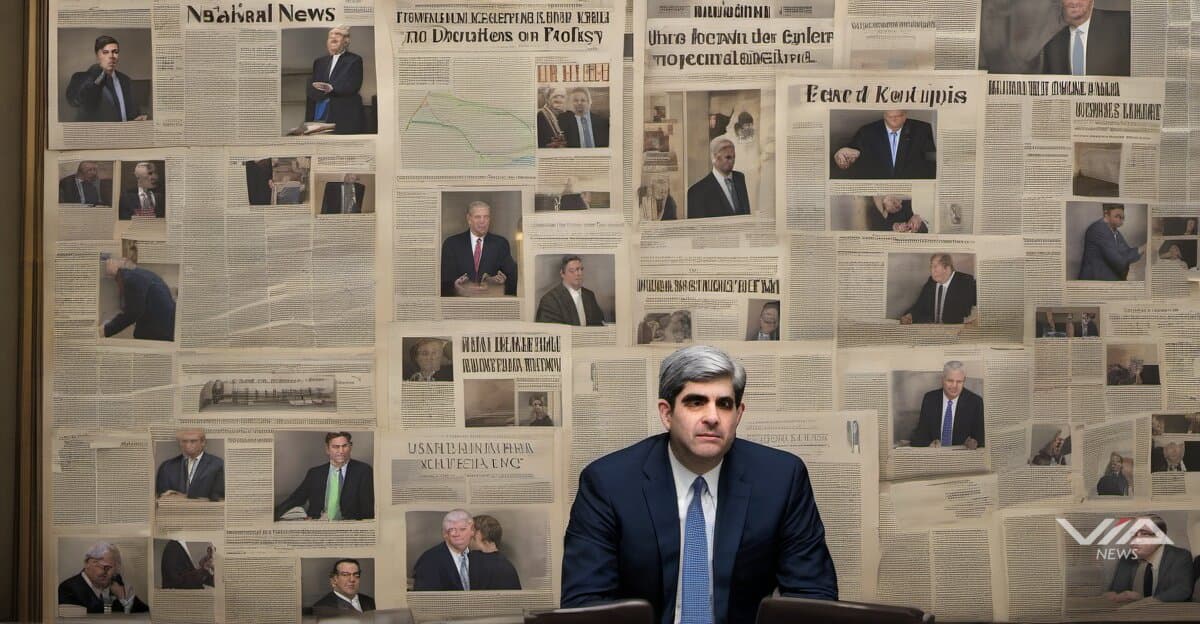
Image generated by AI for illustrative purposes. Not actual footage or photography from the reported events.
Loading stream...

Kevin Warsh is replacing Jerome Powell as Federal Reserve Chair in May 2026.1 Warsh is historically more hawkish and market-discipline-oriented than Powell. The transition creates structural repricing risk for high-growth technology assets.

AI and fintech valuations are highly rate-sensitive. Unprofitable companies in both sectors rely on low discount rates to justify high future cash flow projections. Higher terminal rates compress those projected cash flows directly.

The hawkish shift elevates the probability of a rate path revision upward in H2 2026.1 Bond markets are likely to price in a higher terminal rate ahead of any formal Fed announcement. That repricing hits growth stocks before rate hikes materialize.

Multiple compression is the immediate risk for unprofitable AI and fintech companies. When rates rise, investors discount future earnings more aggressively. Companies burning cash without near-term profit visibility are most exposed.

PE-backed tech deals face additional pressure.1 Tighter credit conditions reduce leverage available for buyouts and growth-stage investments. Deals underwritten at 2023–2025 rate assumptions may require renegotiation.

The AI sector attracted massive capital on the assumption of extended accommodative rates. Infrastructure buildouts — data centers, chip procurement, model training — are long-duration capital projects. They are especially vulnerable to rate-driven valuation resets.

Fintech lenders and payment platforms face a dual hit. Rising rates increase their own funding costs. They also slow consumer credit demand, compressing revenue growth assumptions embedded in current valuations.

Warsh's track record signals less tolerance for financial market stability as a policy objective. Powell's Fed explicitly weighed market conditions in rate decisions. A Warsh-led Fed may prioritize inflation discipline over equity valuations.

For AI investors, the shift changes the calculus on runway and burn rate. Companies that raised at peak valuations in 2024–2025 may face down rounds if the rate environment tightens through H2 2026.

The risk is not a sudden crash but a prolonged multiple compression. Unprofitable companies — those without near-term earnings — face the steepest revaluation. Well-capitalized, profitable AI infrastructure players are better insulated but not immune to sector-wide sentiment shifts.

In this story

About this analysis

This is a Via News analysis. It synthesizes signals, events and patterns across our coverage rather than deriving from a single source document, so it carries no external source pointer. Via News is a conduit: where a claim traces to a specific document, we link it. How we source

LM Salvado

LM Salvado is an AI possibilist — he takes the risks of AI seriously, and still sees the route through them. Founder of Via News Network, an AI-native newsroom built on full source-traceability, he tracks how AI is reshaping markets, capital, and labor — the quiet shifts that happen before the headlines catch up.

What we know · the intelligence behind this page
Live from the substrate
What we're seeing
AI Capital Surge Meets Investor Caution: Record Funding Rounds and Government Contracts Amid Valuation Skepticism
A single-week cluster of large AI/fintech funding rounds (Socure, Stability AI, Emerald AI, Generalist AI, Instinct, Gatik, Regent Craft) shows venture capital still pouring into AI infrastructure, identity, and autonomy plays, while Palantir's Army TITAN contract win coincided with a 6% stock drop — signaling that even flagship AI-defense revenue isn't immune to market reassessment of AI valuations. Efficiency-focused innovations like Multiverse Computing's model compression suggest the sector is also pivoting toward cost/inference economics as capital intensity draws scrutiny.
Our read on the data ›
Signals we're tracking
EPKINLY Regulatory-Clinical Success Cascade
High probability of expanded label indications, additional combination approvals, and competitive positioning strength in follicular lymphoma market. Predicts positive commercial uptake and potential accelerated review for related indications.
Patterns we're watching ›
Where sources disagree
Morgan Stanley & Co. LLC
The same metric (eps) for the same entity (Morgan Stanley & Co. LLC) reported for the identical fiscal period (Q1 2026) and observation date (2026-03-31) has two conflicting values: 3.43 USD_per_share vs 3.08 USD. This is not a temporal change — both observations claim to measure the same point in time. The ~10% discrepancy (0.35 USD difference) is material for a financial metric.
We flag conflicts openly ›
Recently verified
Checked against the original source
4,981
facts traced to their source — and we flag the ones that don't hold up.
101 entities tracked4,981 facts checked against source5,273 source documents archived
Query this data → isubstrate.com